The Manila International Film Festival was set to open its doors to guests on 20 January 1982. The date was nearly a year to the day that strong-man Philippine President Ferdinand E. Marco had lifted his controversial eight-year term of martial law restrictions in the country. But the lifting of the martial law brought only small relief to the majority populace. ThePhilippines was still racked by issues of rampant poverty, wealth inequality and unemployment. Bothpolitical and cultural observers thought itfolly to stage such a gilded film event during this transitional period.The Associated Press reported the festival was toconvene in a building costing some 21.5 million dollars - and still under construction.The film center, designed to housescreening rooms and film laboratories,was to also serve as primary archive of Filipino cinema holdings.
The center, described as an eight-story “Parthenon-like Film Palace” was ordered to be built withinthe time of 170 construction days. In such rushed circumstance, aroof collapse occurredreportedly endingthe lives of some fourteen construction workers. The order to erect thepalatial center wasgiven by none other than Imelda Marcos, first lady of the Philippines, often chided for her “edifice complex” excesses. Many saw this wild expenditure as sorry government decision-makingconsidering the nation’s significant economic issues. But Marcos – appearing before the press in a pair of lovely pair of shoes, no doubt – saw it differently.
Marcoscountered that a strong Filipino “film industry would help reduce Manila’s crime rate, because it would give people something to do in their leisure time.” But she was also mindful that a prestigious festival might burnish her country’s damaged image worldwide – all those pesky claims of human rights violations continued to dog the regime.Though anti-Marco forces promised to disrupt the festival should it be held, the army was prepared to protect. There was, thankfully, no violence.
On 2 February 1982, a correspondent from Variety sent in a dispatch from the inaugural staging of the twelve-day festival. The report made note that Filipino film product wasn’t often seen outside the borders of the Pacific island nation. He reasoned this was due to the selling inexperience of local producers. They had worked in isolation for so long, they simply were not familiar with the film industry’s “aggressive marketing tactics.” Two months prior to the actual staging of the event, Variety described how “reluctant” Filipino producers had been invited to a seminar – one designed to stoke their “sales offensive” skills through “showmanship” tactics. But the trade sighed that despite the well-intentioned marketing teach-in, the Filipino film industry had been too long xenophobic, their business-side interest mostly “half-hearted.”
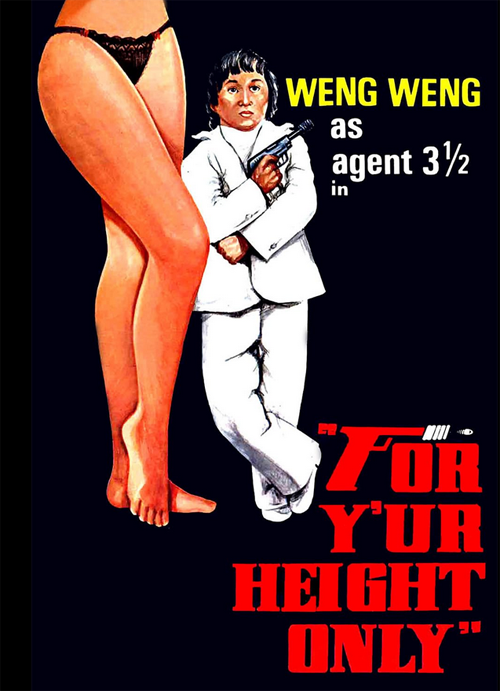
Regardless, and despite many boycotts of the Marcos-inspired event, there was a bubbling of international interest in Filipino film product. Brokers had expressed significant interest in buying distribution rights to eight of the Filipino features offered and available, the sum of those investments bringing sales of nearly a half-million dollars to local producers. Nearly 300 films had been made available to international film brokers at the event, sixty of Filipino provenance. One of the most popular Filipino films – described breathlessly as the festival’s “Top scorer by far” - was an unusual, over-the-top secret agent pastiche featuring a two-foot, nine-inch actor named Weng Wengas central hero. (Critic Alexander Walker of London’s Evening Standard would mockingly describe the diminutive Weng as “a James Bond type cut-off”). The Weng film, directed by Eddie Nicart, was mischievously titled For Y’urHeight Only, an obvious word playon the most recent James Bond screen adventure For Your Eyes Only.
I can’t say with certainty that For Y’ur Height Onlyplayed the grindhouse theaters of “The Deuce” on Manhattan’s 42nd Street, but the film would have fit in well there. It’s a spy-film fever-dream of sorts: thecrack addicts and alcoholics in the grungy red seats could awake from their own narcotic-fed hallucinations and behold images on screen even wilder beyond their own madness’s.This was James-Bond-on-a-budget.A very low budget.Weng’s “Agent 00” is even introduced via an ersatz 007 gun barrel sequence, the moment heightened by the pulsing –and very familiar – opening strains of John Barry’s “James Bond Theme.”
The film itself is all spy-film formula.For Y’ur Height Onlyopens with the kidnapping of a scientist who holds the secret formula to a coveted “N Bomb” weapon. The syndicate behind the kidnapping is led by the mysterious “Mr. Giant” who chooses to communicate withhis minions through a blinking-light, oversized facial mirror.Mr. Giant’s crime syndicate is not, all things considered, particularly political. They also dabble in street-level crimes: drugs, prostitution and theft. They’re a cabal of rogues,openly declaring, “The forces of good are our enemy and they must be exterminated.”
In reaction to the kidnapping, little-person Agent 00 (Weng, described as a “man of few words”), is summoned to report to the office of an ersatz “M.” Weng’s boss breaks down the situation before offeringthe agent a staggering number of gadgets to put to use while working in the field. These include a pen that “doesn’t write words,” a tiny jet-pack, and a razor-brim hat with boomerang-return capability. Of courseWeng manages to dutifully employall of these gadgets while targeting the evildoers: one minion remarks, inarguably, that Wengis “a one-an army,”anothertags him as the “scourge of the secret service.”
Honestly, Weng hardly requiresall the gadgetry. He parachutes from the top of a high-rise building using an ordinary bumbershoot for ballast (think Batman ’66 Penguin-style). But he more often employs his karateskills to bring down platoonsof bad guys with multiple sharp kicks to their groins.Weng also appears a lot smarter than his adversaries as well: he’salways a step or two ahead of theircounter-moves.In a filmbrimming-to-the-edgeswith non-stop action, Weng is constantly seen climbing above or understructures orsliding across floors to vanquish evil gunmen. The film reaches its climax when Weng engages in mano a mano fisticuffs with Mr. Giant, at the villain’s secret lair on a hidden island.
I believe it’s reasonable to saythat for all of its eccentric, energetic charm, For Y’ur Height Onlyis completely and utterly bonkers.It’s also a very cheap looking feature film, the settings gritty and tawdry, the scripting ridiculous. The faces of the entire cast are entirely covered in the glistening sheen of South Pacific humidity and sweat. The film’s atrocious dubbing (from native Tagalog to English) – not the fault of the original filmmakers, of course – burdens the soundtrack: an additional later ofaural nonsensetocompliment the madness on screen.Though For Y’ur Height Onlyis often categorized as an “action-comedy” the original filmmakers took exception, arguing it was no such thing. In their mind, they had made a straight-up formulaic spy film, albeit one with an unusual actor in the lead role.
Following the great reaction and interest inFor Y’ur Height Only at the Manila fest, there were discussions of grumbling embarrassment among Filipino artists and intellectuals in attendance. How could this amateurishly produced extravaganza of pure exploitative nonsense have bested the country’s more significantly erudite and artistic entries?But the film brokers at the festival weren’t highbrows. They were interested in buying cheap and making a few dollars off this novelty spy adventure. Kurt Palm of West Germany’s Repa-Film Productions,purchased the rights to For Yur Height Only(and two other of Weng’s films) for $60,000. Sri Lanka chipped in an additional $1500 for Height rights. Before the festival closed,the producers had sold export rights of Height to distributors in Belgium, France, Indonesia, Italy, Morocco, Nigeria and Switzerland, as well asa number of South American countries.Continue reading "AGENT DOWN: THE IMPROBABLE RISE AND SAD FALL OF SECRET AGENT "OO""
Cinema Retro columnist Brian Hannan takes a sentimental journey back to 1967 to review "B" movie producer Sam Katzman's teenage exploitation film, "Riot on the Sunset Strip". Never shy about using hyperbole, Katzman's trailer for the film immodestly calls it "The most shocking film of our generation!" Click here to read on Brian's addictive blog The Magnificent 60s.
The
Titanic's sinking occurred over 111 years ago and yet it still holds a special
place in not only history, but popular culture as well. If you are reading this
you probably know its history already. It crashed into an iceberg on its maiden
voyage from Southampton, England to New York City. One thousand, five hundred
and twenty two men, women, and children perished in the freezing water.Whether from James Cameron's Oscar- winning
film, multiple documentaries throughout the years, or the smash hit stage musical
being reviewed here (the filmed version), people have been drawn to its tragic
story.
The
musical first opened on Broadway April 23, 1997 and ran for 804 performances.
It
won
all five Tony Awards it was nominated for, Best Musical, Best Book, and Best
Score, along with Best Orchestrations and Scenic Design, and successfully
toured both the US and Europe for years. In its current "revival"
Fathom Events, along with By Experience, are bringing the production of the
recent UK tour to the silver screen.I
did not see the original production. I feel it puts me in a better position to
review this filmed version as I have no preconceived notions or memories about
the show.
Twenty
five actors perform in this filmed version as opposed to forty three in the
Broadway production. From what I read about the Broadway version, the set was
so expensive (it tried to encompass all three classes of passengers along with
the ship's bridge), there were no out-of-town tryouts. In this filmed version,
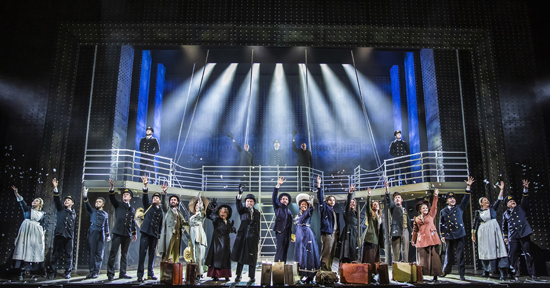
since it was a tour, the producers made a similar, if smaller set for the show,
but whether it was or not a recreation, it is, once getting past slight
distractions, a very good set.
(Photo: Pamela Raith)
The
cast is terrific. Standouts are Martin Allanson as J. Bruce Ismay, director of
the White Star line, the "Villain" of the show, cast with a Snidely
Whiplash moustache is, if not "evil incarnate," than at least
"evil a-boat-ate."Graham
Bickley as the put-upon by Ismay ship's Captain Edward Smith, is one of the
most sympathetic characters, Alice Beane, as portrayed by Bree Smith is the
social climbing, selfish wife who sneaks into First Class to hobnob with the
hoi polloi who puts her marriage at risk. Adam Filipe as Stoker Frederick
Barrett is an experienced stoker, who becomes engaged to be married through the
wireless while at sea. He knows the voyage is at risk due to Ismay's
machinations to increase the ship's speed to set the Atlantic crossing speed
record.
To
list all the wonderful performances and numbers would take too much time and
effort, as I am not being paid by the word.
This
filmed version will be available to see at over 700 U.S. theaters country-wide
on November 4th and 8th. At approximately $20/a seat, it is a whale of a
bargain to see this multi-award winning show.
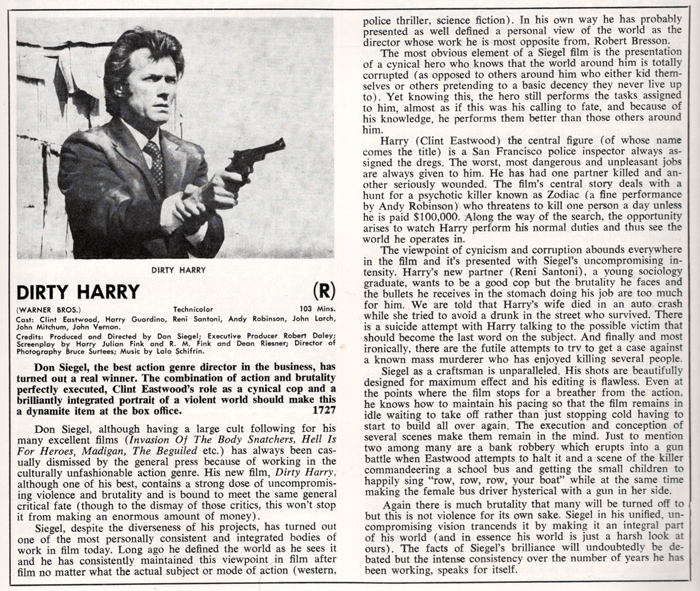
Review of Clint Eastwood in "Dirty Harry" from the Independent Film Journal trade magazine, December 23, 1971. As was the custom in that era, the reviewers toiled anonymously and didn't receive a byline.
Here's a fun video essay from Turner Classic Movies about sci-fi movies that are regarded as "camp". The emphasis is on some obvious choices: "Plan 9 from Outer Space", "Queen of Outer Space" and "Barbarella"- but it also covers the lesser known cinematic disaster, "The Apple". The video addresses the debate over whether a film can be intentionally designed as "camp" or if that designation only comes about as an unintentional consequence.
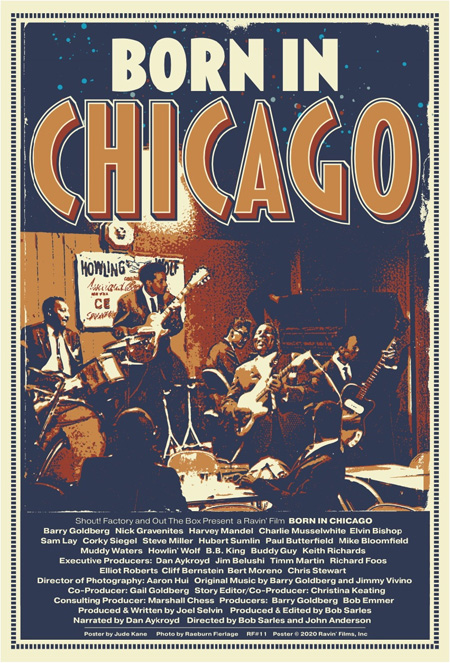
The fifteenth annual New York City Independent Film
Festival was held during the week of June 4 through 11 at Manhattan’s
Producer’s Club on West 44th Street, a few blocks west of Times
Square.The week-long festival would
host the screenings of over two hundred indie films. Co-Directors John Anderson and Bob Sarles' absorbing and
authoritatively assembled music doc Born
in Chicago, screened on the festival’s final day, doesn’t pretend to serve
as the definitive nor most academically-minded treatise on the history of blues
music in America.Such studies as the seven-episode
PBS series The Blues (2003) had
already touched lightly on many aspects of multi-layered history of the blues
in America.This film’s primary interest
lies elsewhere.
The state of Mississippi, the birthplace of the blues and
home of some of the music’s greatest practitioners is, of course, referenced
early on in Born in Chicago.But the fertile musical and agricultural area
surrounding the Mississippi Delta region serves merely as the pregnant preface of
what’s to come.There’s no mention that
I can recall of the high-end music of band leader W.C. Handy, the
self-proclaimed “Father of the Blues,” or of Ma Rainy, “Mother of the Blues” or
even of such a master figure as songster Charley Patton, the acknowledged progenitor
of the rough and tumble country blues.
Alan Lomax’s 1941-1942 Library of Congress recordings of one
McKinley Morganfield (soon to be rechristened as “Muddy Waters”) down on
Stovall’s Plantation near Clarksdale, MS is briefly referenced in Born in Chicago, but only in
passing.The film recalls Waters as merely
one of the many immigrant blues singers who, among non-musical travelers and those
feeling racism and economic hardship, would abandon Mississippi - and neighboring
states - to seek employment in Chicago’s burgeoning meat-packing and steel industries.
The blues singers arriving in the Windy City would often perform
for pocket change on Chicago’s fabled Maxwell Street, and there’s a bit of
historic film footage included in the film to document it.But ultimately Born in Chicago assumes that a knowledgeable blues aficionado is already
conversant with the complex reasons that Chicago would birth the raw and
immeasurably emotive electric blues.Born in Chicago soon time-jumps from a
basic introductory primer to a particular moment in history – a period roughly
encompassing 1964 through 1970 - when public interest in the blues music would peculiarly
shift along color lines.
Though the blues was created by black artists for a
primarily black audience, by the mid-1960s it was lovingly embraced by a cabal
of young, white and often gifted musicians. In some sense these mostly suburban
youngsters were oddballs.Not only were
they complete outsiders to African-American life and musical culture, but estranged
from even their own middle-class heritages.The best of them were determined to apprentice with the real-deal blues masters
whose recordings they had painstakingly studied and cherished.
Such Chicago blues artists as Muddy Waters, Howlin’ Wolf
(aka Chester Burnett), and Little Walter Jacobs were at their musical – if not money-earning
career peaks – in the 1950s.Though
Chicago boasted any number of record labels pressing 78 rpm discs of the talent
grinding their music out almost nightly in such saloons as Pepper’s Lounge, Silvio’s,
Smitty’s Corner, Big John’s, the Blue Flame Lounge, and Frost’s Corner, it was
Chess Records that emerged the most important and iconic.Though label co-founder Leonard Chess appears
in an archive footage interview alongside his son Marshall, Born in Chicago wisely chooses not to revisit
the company’s backstory.That’s a tale
already told in several docs as well as in Darnell Martin’s ill-disguised
Chess-mirror fiction-feature Cadillac
Records (2008).
There’s lots of archival footage threaded throughout Born in Chicago.Some of the film’s moodiest and most intimate
saloon environ images come courtesy of several reels of silent B-roll 8mm color
footage shot by drummer Sam Lay and his wife.Lay is an important figure here due to his key role in the blues tradition’s
transition: he not only worked the South Side taverns with nearly all the blues
giants but was also a founding member (along with bassist Jerome Arnold) in the
inter-racial Paul Butterfield Blues Band.
Though not a concert film by any means – all performances
featured in Born in Chicago are
offered in truncated form - there are extended clips of Muddy Waters and Howlin’
Wolf to offer insight into the power of their stage presence and hypnotic
powers.This inclusion is not
unreasonable as the two singers were the figurehead totems of the Chicago blues
scene of the 1950s.Muddy and Wolf were
also among the most generous and least suspicious of interlopers. They were
appreciative of the enthusiasm and interest of these young, white blues
revivalists and allowed them to share the stage and showcase their talents.
Of course, Muddy and Wolf didn’t singularly or together
create the Chicago blues scene.During
the course of Born in Chicago we’re briefly
introduced to a number of the first and second wave Chicago’s bluesmen, as well
as the iconic sidemen who helped create the sound: Otis Spann, Yank Rachel,
Robert Lockwood, Willie Dixon, Junior Wells, Sonny Boy Williamson, Otis Rush,
Buddy Guy, Hubert Sumlin, Magic Sam, Walter and Big Walter “Shakey” Horton all pass
through the film in either image or musical snippet, all honorably referenced as
“engines” of the scene.
Though the blues was derived partly from African musical traditions,
the blues as the world knows it today was birthed in the area of the
Mississippi Delta.Chicago blues was, at
the very beginning anyway, mostly an electric, highly amplified extension of
that earlier homegrown music, improvised out-of-necessity to cut through the
din of celebratory patrons gathered inside cramped and sweaty neighborhood
taverns.
The 1950s was the decade Chicago’s blues scene was at its
creative peak.The musicians who arrived
in Chicago during the great migration from the southern U.S. quickly bonded to
a natural audience.They were warmly
embraced by audiences that were once – and now again - neighbors.The musicians and their fans shared similar customs,
life experiences and musical interests, and such familiarity allowed Chicago’s
blues scene to thrive during the 1950s.
But by the early 1960s, the musical tastes of black
audiences began to shift, particularly among younger listeners.This group held no bonding memories or immediate
connections to blues or rustic southern musical culture.The rhythm-and-blues and soul of Sam Cooke,
Jackie Wilson, and James Brown was in emergence and such artists were now the most
favored of black audiences.It wasn’t
long until the Motown and Stax labels would supplant Chess as the recording
mecca for black artists.
But just as black interest in blues was seemingly on the wane,
there was a sudden curious interest in the art by young, rebellious and hip
Midwestern middle-class whites.Their
passion for the music was often ignited by their discovery of late-night
broadcasts of blues and old-school R&B found on the far ends of their radio
dials.Many of these disciples – which would
include such 1960’s blues and rock luminaries as Barry Goldberg, Michael Bloomfield,
Nick Gravenites, Paul Butterfield, Corky Siegel, Harvey Mandel, Charlie Musselwhite,
Elvin Bishop, Steve Miller and Bob Dylan – are all featured in Born in Chicago.It could be argued they were actually re-born in Chicago.
In any case, this is the time period under analysis in Born in Chicago.Liberal and open-minded students attending (or
merely hanging on the fringes) of the University of Chicago – the campus itself
nestled within the city’s Southside – played a role in the blossoming blues
revival.Through the interventions of on-campus
folk music clubs Chicago U. would stage not only small folk-music gatherings
but several important folk music festivals – several showcasing such blues artists
as Willie Dixon, Memphis Slim, Big Joe Williams and blind street singer Arvella
Gray. This new interest in folk-blues
music brought many students and scene hanger-on’s to Chicago’s pawn shops in
search of guitars and friends and subsequent musical fellow travelers.
The most dedicated – and talented of these musicians –
would reverse “integrate” these black-only Southside blues taverns - often under
the suspicious and unwelcome gaze of black patrons in attendance.But both Muddy and Wolf and their respective
band members would embrace such musicians as guitarist Michael Bloomfield and blues
harpist Paul Butterfield et.al. once they realized these searching white
youngsters – many demonstrating superlative musical talent – were looking to absorb,
as best they could, the essence and emotional comport of the blues.
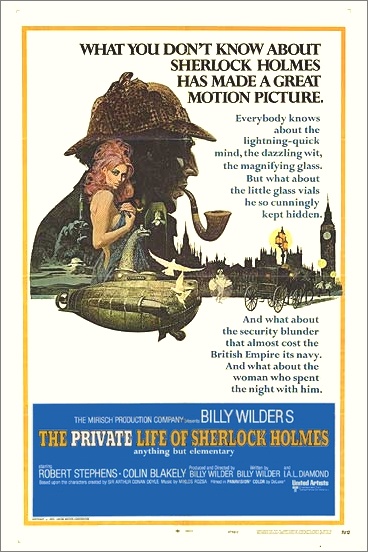
Writer Olivia Rutigliano knows a thing or two about Sherlock Holmes and she's put that knowledge to good use in this article that ranks the best, worst and strangest portrayals of the master detective on screens large and small. This isn't the usual slapped together, meaningless list created to serve as click bait. Rutigliano provides insightful background information on every conceivable portrayal of Holmes and includes stories in which the main character merely thinks he is Holmes. She also includes animated and animal portrayals of Holmes. Chances are you won't have heard of many of the more obscure international inclusions, which makes them even more interesting to read about. Click Hereto do so.
70-year old Philip Marlowe is snooping around in the dark
alleys of an ersatz 1939 Los Angeles beating up punks and turning down sexual
advances from black-eyed blondes. That’s pretty much what we get in the new
Neil Jordan-directed “Marlowe,” the latest in a long line of film noirs
featuring Raymond Chandler’s mythic private dick. He’s been played by Humphrey
Bogart, Robert Mitchum, Dick Powell, James Garner and Robert Montgomery, and
others. Seventy-year-old Liam Neeson, in his 100th movie, takes a
crack at the character this time around, and comes off a bit shopworn and
somewhat out of focus.
One reason for the slightly out of focus presentation of
Chandler’s urban knight—the man who lives by a code and walks the mean streets
of LA “neither tarnished nor afraid,” – is that the script by William Monahan
is based not on one of Chandler’s novels, but on a “Chandler-estate-approved
novel” called, “The Black Eyed Blonde” by Irish novelist John Banville. The
novel and the film have a seemingly simple plot. Claire Cavendish (Diane
Kruger), a married blonde heiress with black eyes, hires Marlowe to find Nico
Peterson, her missing lover, a movie stunt man. Of course, nothing is ever
really that simple in a Marlowe story, because no sooner does the investigation
get underway than Nico turns up dead in a parking lot of the Cabana Club with
his skull crushed by a car, which makes a positive identification somewhat tricky.
Except his body was identified by his sister. That seems to settle the matter
of identification, until later on the sister is beaten, tortured and killed,
and Marlowe wonders what’s up with that?
Marlowe’s employer refuses to believe that her lover is
dead. She wants him to keep digging and find out if he’s alive and where he’s
hiding. Marlowe’s quest for the truth brings him into contact with the usual weird
assortment of film noir characters, including Dorothy Quincannon (Jessica Lange,
who is first presented as Claire’s mother and then in a plot shift that seemed
borrowed from “Chinatown” turns out to be Claire’s aunt. “She’s my daughter.
She’s my niece. She’s my . . .”) In fact, the shadow of “Chinatown” looms even
more ominously over “Marlowe” with the introduction of night club owner Floyd
Hanson played by John Huston’s son Danny Huston, who basically gives Marlowe
the old spiel John Huston’s Noah Cross gave Jake Gittes about life being so
fouled up it’s impossible for anyone to do any good in this world. But that
doesn’t stop Marlowe. He keeps sniffing and snooping, running into creeps like crooked
antiques dealer Lou Hendricks (Alan Cumming), a cross between Clifton Webb and
Tennessee Williams, and his driver Cedric (Akinnuoye-Agbaje), who’s pretty big
and pretty handy with a machine gun.
Jordan, Monahan and Neeson try their best to do justice
to Chandler’s Marlowe, but it’s hit and miss at best. Neeson pulls off the
“world-weary hero” look, but it’s obviously not much of a stretch. There’s basically
some inconsistency in Monahan’s script. At times the characters utter lines
that cop quotes from Christopher Marlowe, with references to the Bard, that somehow
seem as artificial as a BBC teleplay. Marlowe keeps telling everybody he’s just
an average guy, a working stiff, but still everyone treats him with some kind
of awe, with one character telling him he lives like a monk. It’s like the
filmmakers on one hand want to show Marlowe is just a tough guy doing
everybody’s dirty work, nothing special, while at the same time trying to
canonize him as a saint.
The use of locations in Barcelona and Dublin shot with a
reddish filter give “Marlowe” a dated look, but there are few if any wider
shots showing L.A. as it was in1939 so you get a claustrophobic feeling. You
wish Neeson would wander off the set once in a while and get a drink somewhere
in a bar down on Long Beach, with the oil wells pumping in the background. L.A.
was always a character in Chandler’s books. Its absence here is a real
handicap. Another troublesome aspect is David Holmes’ soundtrack score. The repeated
use of “These Foolish Things” in the background, kept reminding me more of Monica
Lewinsky (it was her and Bill’s favorite song, according to her) than the plot
involving Claire Cavendish. And there is one scene where Marlowe drives his
Plymouth coupe onto the grounds of a palatial chateau where the band playing
“Brazil” at full volume sounds more like Ernie Kovacs’ Nairobi Trio. Why were
there so many Tangos played over the course of a film set in ’39 in L.A.?
A weird side note: “Marlowe” is no classic, but it does
have something in common with one of the great ones ---Howard Hawks’ classic, “The
Big Sleep (1946).” When Hawks was filming “The Big Sleep,” (1946) there’s a
scene where a limo drives off a pier and the driver drowns. The screenwriters
(Leigh Brackett, William Faulkner, and Jules Furthman) asked Hawks who killed
him. Hawks didn’t know and they contacted Chandler and he said he didn’t know
either. In “Marlowe” someone is killed and has his skull crushed so it would
look like it was Nico Peterson. But it turned out it wasn’t Nico. So who was
it? Never explained. Who cares? Just
another bit player, another nameless face lost in the blurry background of
Tinseltown.
“Marlowe” may not go down as a great addition to the
Marlowe canon but it’s better than nothing and despite its flaws, it is good to
see serious movie makers trying their hand at it, even if not that
successfully. There’s a need for someone to do Philip Marlowe justice,
especially now.
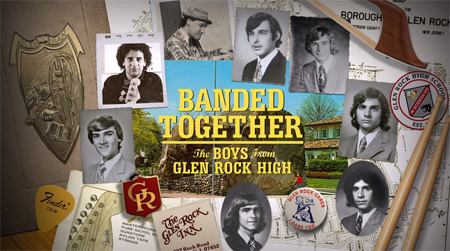
This review will bring readers good news and bad news. The good news is that director Barry Rubinow's new documentary, "Banded Together: The Boys from Glen Rock High" is one terrific documentary. It's packed with laughter, sentiment and some great music, as he assembled some of his former classmates from the Glen Rock, New Jersey High School, which they attended in the early 1970s. All of the guys who formed an ad-hoc band went on to bigger and better things in the field of music and they credit their music teacher, Joel Sielski, with their success due to his inspirational methods of teaching. I recently saw the film screened on the final day of the Montclair Film Festival in New Jersey where it received a rousing reception. Rubinow was in attendance and hosted the band members, who have continued to perform together occasionally over the decades, on stage for a Q&A session. Most gratifying was that Joe Sielski, who figures prominently in the film, was there to accept the plaudits. The film is one of the best documentaries I've seen in many years but that leads me to divulging the bad news: you can't see it anywhere. That's because Rubinow has not been able to land a distribution deal anywhere and he's hoping the buzz from the festival will help him to do so.
The film presents the musicians (brothers Jimmy Vivino, Floyd Vivino and Jerry Vivino, Lee Shapiro, John Feeney, Frank Pagano, Doug Romoff and Jeff Venho) as they assemble once again to perform some sets and sit for group interviews with Joe Sielski. They talk a great deal about their hometown of Glen Rock, New Jersey, a small suburban town with a population of 12,000 in north Jersey defined by its unique centerpiece in the middle of town: a giant rock that weighs 570 tons and is said to be 15,000 years old. All have fond memories of the place and most still live in town or nearby. You don't have to be from Jersey to appreciate their humorous tales but it helps if you are tuned in to Jersey Guy traditions such as never saying a kind word to your friends and expressing sentiment towards them through ball-busting put-downs. Funniest of all is the most celebrated of the group, Floyd Vivino, who is a Jersey comedy legend who is known as Uncle Floyd. His unabashed old-fashioned shtick is in the tradition of Rodney Dangerfield and Henny Youngman. (In the Q&A, Floyd imitated Don Corleone, saying "I told Sonny to use EZ-Pass!", a reference to the car tag device New Jersey drivers use to breeze through the toll booths without stopping.) The guys relive how fabulous it was to grow up in a period when music was so exciting and inspiring. Some of them went on to play in bands with the likes of Bruce Springsteen, the Ramones, Frankie Valli, Tony Bennett and other exalted names. Conan O'Brien appears in various segments extolling their talents, as Jimmy Vivino was a member of his TV show's band.
"Banded Together" is a fun ride throughout, especially if you came of age in the 1970s. It's also great to see a film in which a teacher is a revered hero. Kudos to Barry Rubinow for turning his labor-of-love into a highly entertaining experience that is truly is a "must-see". Hopefully, there will be a place to actually see it soon. We'll keep readers posted.
Writing on the Digital Bits web site, film historian Michael Coate is always known for presenting interesting and informative articles about the making of classic films and their legacies. However, his tribute to "The Godfather" may well be his most ambitious and best in terms of the amount of data he provides. It ranges from samples of original reviews to an exhaustive list of when and where the film played in U.S. theaters. On page 4 of the article, Cinema Retro Editor-in-Chief is interviewed along with other film historians regarding his memories of seeing the film for the first time. Click here to read.
Have you ever seen a high school yearbook from the 1940s or 1950s?
The graduates' photos make them appear to be in their mid-twenties. They look
much older at 18 or 19 than we did in our photos. That was the first thing I
noticed when I first saw director Mike Nichols' “Carnal Knowledge”
in the 1970s and was reminded of again now, with the
new 4K restoration now being shown at the Film Forum in New York City. The film traces the relationship between
former college roommates through 25 years, from the late 40s to the early 70s.
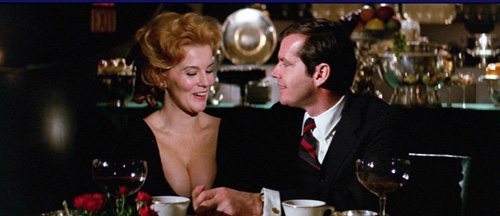
Jack Nicholson and Art Garfunkel, as roommates at Amherst College, look a
little too old to be students there. But we're eventually lulled in to
accepting them as such by the dichotomy of their personalities and their acting
abilities.
The film opens in the dark. Literally. We hear the voices of the
two roommates discussing women and sex in the dark of their dorm room. We never
see their faces until the next scene; at a college mixer where we followed
Susan (Candice Bergen) into the dance.Sandy (Art Garfunkel) is immediately attracted to her. Jonathan (Jack Nicholson)
coaches the shy, sensitive Sandy in what to do to break the ice. Seeing this
scene today made it impossible not to recall the villainous Joker grin on
Nicholson's face we would come to know well. Which works very well for the
character of Jonathan, the tough, aggressive misogynist who ends up cuckolding
his best friend and roommate.
When the film opened back in 1971 America was going through
societal changes. The Vietnam War was in full swing, and the youth of the
country were protesting. They were also embracing the sexual freedom boom. In
1969 "I Am Curious (yellow)," a Swedish erotic drama that opened
there in 1967,
made it to American shores. Nudity appeared on the Broadway stage
with "Hair" in 1968 and "Oh! Calcutta!" in 1969. Societal
mores were changing. The Sexual Revolution was in full attack mode with women
wearing miniskirts, see through shirts and hot pants. Woodstock. Flower Power.
Psychedelics. Hippies. "Foreign" films (read: obscenity to many) were
being banned in a number of states. The Generation Gap was being covered in
newspapers and news magazines. In the face of it all, never missing a beat, the
entertainment industry began to embrace counter-culture in way they never had before.
The cultural bandwagon that spawned the summer of love spread from Haight-Ashbury
to Greenwich Village, possibly in VW vans trailing
"aromatic" smoke clouds in their wake.
Jules Pfeiffer originally saw this as a play, but upon showing it
to friend Mike Nichols, was convinced it would be better made as a film. And as
a film it has grown better with age. Specifically, this reviewer's age.
Dialogue that went over my head, or that I had found both puerile and stuffy,
resonated clearer while they were dancing in my older brain. This film has a
lot to say about life and the relationships we allow ourselves to suffer
through.
Back to the film:
Sandy scores a date with Susan and the two shy virgins begin a
relationship. All the stupid, testosterone- fueled braggadocio that
rears its head in most adolescent (and collegiate) males arises like the mist
that surrounds the roommates as they walk to their dorm while Jonathan pumps
Sandy for information about his latest date with Susan. Even the shy Sandy
comes out of his shell to brag about how he got beyond the kissing stage of his
and Susan's relationship. This leads to Jonathan calling Susan and eventually
the two of them begin to sneak around behind Sandy's back.
Advancing
into Act II, sometime into the late 50s - early 60s, Sandy is married to Susan.
He meets Jonathan at an ice rink where they watch a beautiful skater (Ann-Margaret, in an Oscar-nominated performance)
from a distance and talk about, what else? Women. Jonathan's take: "You
think a girl goes for you, and you find out she's after your money or your
balls. Women today are better hung than the men."He continues to ramble, slightly to Sandy's
disgust. "It's not as easy getting laid as it used to be," Jonathan
complains, "I don't think I fuck more than a dozen new girls a year
now."
We
find Jonathan out with Bobbie, the gorgeous, redhead with the "tits"
and "ass" Jonathan's looking for in a woman. They eventually shack up together, at Bobbie's suggestion and Jonathan convinces
her to stop working. This causes the relationship to deteriorate as Bobbie
doesn't know what to do with herself all day long alone in the apartment and
Jonathan complains that the place is a pig sty. Sandy,
meanwhile, complains to Jonathan about his life with Susan: "It's funny,
Susan and I do all the right things. We undress in front of each other. We
spend fifteen minutes on foreplay. We experiment, do it in different rooms,
it's a seven-room house. We don't believe in making a ritual of it, we do it
when we feel like it. We don't feel like we have to be passionate all the time.
Sometimes it's even more fun necking," he goes on, finishes with:
"Maybe it's just not meant to be enjoyable with women you love."Jonathan replies: "Sandy, do you want to
get laid?"
No
surprise here; Sandy and Susan divorce. Sandy begins seeing Cindy (Cynthia
O'Neal), a modern, empowered, smart woman. The couples spend a lot of time
together. Things are nearing the end for Bobbie and Jonathan; he doesn't want
children and doesn't want to marry Bobbie. Before Cindy and Sandy arrive at
their apartment Jonathan and Bobbie get into a heated argument that finds
Bobbie not fully dressed in the bedroom. Things come to a head and a disturbing
end when, while at Jonathan's apartment he suggests to Sandy that they swap
women and Sandy goes along with it.
Advancing
to Act III, late 60s - early 70s, middle-aged Jonathan presents a slide show
"Ball-Busters on Parade," at his place showing the loves of his life
to a hippyish, middle-aged Sandi and Jennifer (Carol Kane), his eighteen-year-old
girlfriend. Jonathan mistakenly shows a slide of Susan, but Sandy notices.
Jonathan, showing a slide of Bobbie, "The king of the ball-busters. She
conned me into marrying her and now she's killing me with alimony." As he
continues his narration, he becomes angrier, vulgar and misogynistic. Then he
insults Jennifer and she and Sandy walk out without a word.
A
nighttime walk with the two old "friends" is the last time we see
them together. The conversation teeters between the then and now, the us and
them. Jonathan makes fun of Sandy's relationship with Jennifer. "She knows
worlds which I cannot begin to touch yet," Sandy tells him. "You give
up bad vibrations." "Sandy I love you," Jonathan retorts,
"but you're a schmuck." Sandy tells Jonathan he can find what he's
found. The last words we hear between the "friends" are Jonathan's:
"Don't make me insult you."
The
film ends with, after a time passage, Jonathan going to Louise's (Rita Moreno)
apartment. Louise is a prostitute for whom Jonathan is a regular customer.
Louise performs a monologue/dialogue that also seems to be part of their usual
routine. At one point she messes it up angering Jonathan. Obviously, it's
Jonathan's creation, and the only thing that can get him erect is to hear her compliment
his virility.
“Carnal
Knowledge” was so controversial in 1971 that, after a conviction of a theater
manager, Mr. Jenkins in Albany, Georgia for "distributing obscene
material" was upheld by the Supreme Court of Georgia, the US Supreme court
overturned the conviction: "Our own viewing of the film satisfies us that “Carnal
Knowledge” could not be found … to depict sexual conduct in a patently
offensive way. Nothing in the movie falls within … material which may
constitutionally be found … "patently offensive" … While the subject
matter of the picture is, in a broader sense, sex, and there are scenes in
which sexual conduct including "ultimate sexual acts" is to be
understood to be taking place, the camera does not focus on the bodies of the
actors at such times. There is no exhibition whatever of the actors' genitals,
lewd or otherwise, during these scenes. There are occasional scenes of nudity,
but nudity alone is not enough to make material legally obscene… Appellant's
showing of the film “Carnal Knowledge” is simply not the "public portrayal
of hardcore sexual conduct for its own sake, and for the ensuing commercial
gain" which we said was punishable…"[1]
The
film received mixed reviews. Roger Ebert called it "clearly Mike Nichols'
best film." Others were not so kind but there were more positive reviews
than negative. Vincent Canby: "a nearly ideal collaboration of directorial
and writing talents" that was "not only very funny, but in a casual
way—in the way of something observed in a half-light—more profound than much
more ambitious films."Gavin
Millar: "Though not the last word on the subject, it's still a telling and
unhysterical assault on male chauvinism; and if that's fashionable, it's not
unwelcome." "The iciest, most merciless and most repellent major (and
seriously intended) motion picture in a very long time." - Charles
Champlin. "Basically a one-note story ... The characters do not change or
learn; they do not even repeat their mistakes in very interesting ways." -
Gene Siskel. "This movie says not merely that there are some people like
these, but that this is it—that is, that this movie, in its own
satirical terms, presents a more accurate view of men and women than
conventional movies do. That may be the case, but the movie isn't
convincing." - Pauline Kael.
“Carnal
Knowledge” is sometimes referred to as a "coming of age film." But do
people actually come of age when they seem to be incapable of maturing? It's a
film that can make one examine and question the relationships in their lives.
How long does one put up with a toxic person? How bad is someone's insecurity
that they need constant, positive, reinforcement in their lives? “Carnal
Knowledge” is a great film but not necessarily a good story.
The
new 4K restoration will be running at the Film Forum in Manhattan from Sept. 2
- Sept. 8. Details on the Film Forum's website:
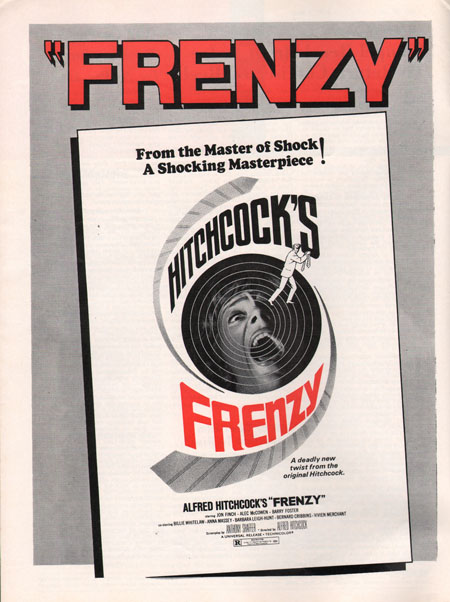
Sandwiched
between the unfortunate Topaz (1969), which Hitchcock described as an
‘ordeal,’ and his final film, the trifling Family Plot (197), about
which many have been altogether too kind, Frenzy (1972) was the final efflorescence
of Hitchcock’s diabolic, virtuoso talent. He hadn’t had a box office hit since The
Birds, and hadn’t deserved one. Frenzy was both a critical and
commercial success. In the intervening fifty years since its release its
critical stock hasn’t declined, yet is still the least known and least written
about of Hitchcock’s handful of masterworks. This is perhaps because it wasn’t
a star vehicle, though it did feature the leading British theatrical talent of
the time, perhaps because it is the most misanthropic, if not nihilistic of his
films, with an overarching air of grubbiness.
The
failure of Hitchcock’s post-Birds films has generally been discussed in
terms of age and artistic decline, but these films were farragoes due to
factors beyond the director’s control, and in any case Hitchcock’s career was from
the start one of peaks and troughs, of films such as Stage Fright (1950),
Lifeboat (1944) and Rope (1948), that didn’t come near the delirious
aesthetic heights of Vertigo (1958), Frenzy, Psycho (1960)
or The Birds (1963). Frenzy was just another artistic crest and
was the last simply because he didn’t have enough time on earth left for
another.
If
Frenzy hasn’t aged one whit it is because although ostensibly set in 70s
London, with a significant part of it shot on location in Covent Garden, it is
actually set in a purely cinematic, Hitchcockian, time-transcending London.
Hitchcock and his writer, Anthony Shaffer (Sleuth, The Wicker Man)
had the film’s characters speak a slightly archaic diction, to evoke the London
of Jack the Ripper, Crippen, Christie and that of Hitchcock’s first film, The
Lodger (1927), like Frenzy, the story of a woman-murderer at large,
and a man on the run falsely accused of his crimes.
Frenzy
is hardly the ‘love letter’ to the London Hitchcock was born and grew up in
some have lazily taken it to be purely because he returned there towards the
end of his life. Rarely has the city looked so unlovely on screen, squalid
even, with an excremental brown dominating the film’s palette. The city, which
he left for good in 1939, is the setting for themes of the failure of love and
friendship, of humans bestially devouring each other, a seamy setting for
debased and degenerate crime. Much is made of the Covent Garden setting (Covent
Garden was set for demolition in 1974, and it is fascinating to see the area as
a working market), but this is more to do with the motifs of food, eating and
waste running through the film, rather than fond memories – after all the
killer is given the same trade as Hitchcock’s father – a Covent Garden
Greengrocer.
The
film opens with a piece of mordant irony: the camera swoops over and down the
Thames, through Tower Bridge to soaring, majestic, even pompous orchestral
music that might soundtrack a tourist information film. It alights riverside on
the steps of City Hall where an MP is giving a flatulent speech, promising to
clean up the polluted river. Amongst the clapping, animated crowd stands a
motionless, expressionless, black-clad Hitchcock, glaring balefully head. No
whimsy here, in this cameo he is Death. Someone in the crowd spots a woman’s
naked corpse, face-down, bum-up, floating in the Thames, with the necktie that
strangled her still around her neck. From soaring celebratory grandeur to the
utmost sordor of an abused human body become mere waste, part of the estuarial
muck, shat out by death.
And
cut to Richard Blaney (Jon Finch) doing up is tie at the mirror. There’s a
killer on the loose again, an old London story. But it isn’t Blaney. He’s on
his uppers, working as live-in barman, and about to be sacked for helping
himself to the brandy. He’s suspected of being the killer when his estranged
wife Brenda (Barbara Leigh-Hunt) becomes one of the victims after he’s seen
leaving the matrimonial agency she runs just before her dead body is discovered,
the real killer having locked her office door behind him. He goes on the run
and his girlfriend, Babs (Anna Massey) becomes the next victim. Blaney is
caught, sentenced, imprisoned and escapes, intent on the revenge murder of the
real killer. Not as improbable, plot-wise, as it sounds, because the real
killer is Blaney’s friend Rusk (Barry Foster, who would soon hit pay dirt as TV
cop Van der Valk), a becoiffed and dandified Jack-the-Lad and Mummy’s Boy,
and a regular at the pub where both Blaney and Babs work. We know he’s the
killer less than fifteen minutes into the film, creating unease in every scene
in which he appears. He’s, likeable, helpful, everyone’s obliging friend,
though he lets slip his nihilistic cynicism and misogyny several times in his
banter.
It
is hard to sympathise with Blaney, a sullen, sponging, fractious, bitter and
rude malcontent: Hitchcock wanted to portray him as a perennial loser. In
Hitchcock’s other innocent-man-accused films we root for the characters not
just because of their innocence but because of their charm. Even in Hitchcock’s
most dour film, The Wrong Man (1956), a film of almost Bressonian
austerity, the protagonist, played by Henry Fonda, is decent, and a loving
husband.
Hitchcock
had recently seen Jon Finch as the intense lead in Polanski’s Macbeth (1971),
still the best Shakespeare on film. But he didn’t like him. Or at least he
pretended not to: his constant cold-shouldering of the actor on set seriously
affected Finch’s mood during filming, and made his performance edgier, moodier,
more frustrated.
Blaney
is unaware that Rusk is one of his wife’s would-be-clients: Rusk wants her to
find him a woman with ‘certain peculiarities,’ by which we’re meant to
understand a taste for masochism. She refuses to help him. He rapes and murders
her in his office after pleading is case. The scene lasts for a gruelling
twelve minutes. Stylistically it was departure for Hitchcock in his depiction
of murder, lacking all legerdemain, filmed in real time, without music,
without ostentatious cuts. It is in no way, thrilling, is entirely anerotic. It
is disgusting. Increasingly menacing dialogue presages the violence; a queasy
apprehension of fear, predatoriness and impending savagery is achieved with
dolly zooms. The increased freedoms from censorship allowed Hitchcock to depict
violence towards women in its repellent, pathetic squalor, to become not a
pseudo-pornographer but a severe, despairing moralist. Rusk picks up Brenda ‘s
half-eaten apple after he has killed her and casually takes a bite, his dessert.
(Rusk eats after both murders in the film and is constantly seen snacking and
handling food.) The scene is Ackermanesque – if it had been shot by a woman it
would have been hailed as proto-feminist.
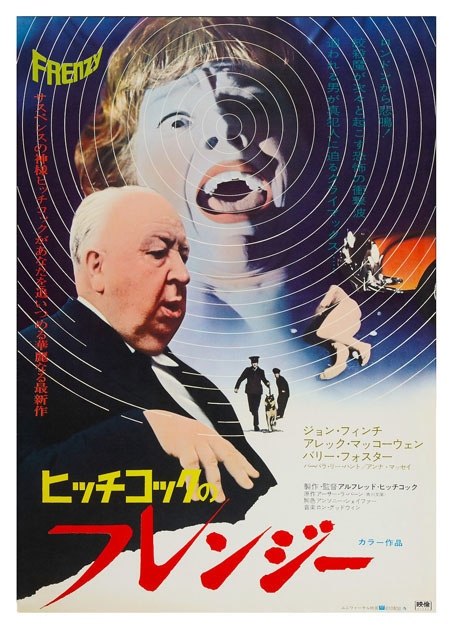
Original Japanese poster.
The
final shot of this sobering scene, Branda Blaney’s goggle-eyed death stare, and
swollen, grossly protruding tongue, has been described as ‘cartoonish’, but in
fact is a highly realistic depiction of the face of a strangled-to-death human.
Hitchcock was a connoisseur of corpses and the grotesque attitudes of death. In
1945 he was recruited to oversee the editing and appointed Supervising Director
of a documentary made from footage of the Nazi concentration camps shot by
Allied and Soviet troops called German Concentration Camps: Factual Survey
(it was not shown until 1984, released under the title Memory of the Camps,
with a later version that included an omitted sixth reel released in 2014). Hitchcock
sat through four hours of some of the most distressing images ever filmed and
was traumatised by it, staying away from the studio for a week and refusing to
watch any of it a second time.
It's summer and that means the world's social media engages in the annual ritual of reporting every sighting of a shark as though you won't be safe in your own bathtub. It's also a time of year when writers tend to look back on the legacy of "Jaws". But writer Dennis Perkins of the UCR web site takes a different tact by looking back at the last and least of the "Jaws" franchise entries: "Jaws: The Revenge", a movie so bad that even star Michael Caine claims to have never seen it. Perkins examines all aspects of the production including numerous continuity errors and comes to the conclusion that the film is so awful that it doesn't rise to the status of "so bad, it's good". Click here to read.
Like his father
director Ralph Thomas (Doctor in the
House films) and his nephew Gerald Thomas (Carry on . . . film series), Jeremy Thomas always wanted to be a
part of the British film industry. Unlike his relatives, twenty-year old Jeremy
didn't want to make the typical British films. The young filmmaker saw himself
as a "disruptor" and "sounding board" for new "unconventional
ideas." His social connections in the early1970s with Philippe Mora, Mike
Molloy and the artists' community of The Pheasantry at King's Road initiated his
interest in Australian culture. In 1975, screenwriter Michael Austin contacted
Thomas with a script proposal based on a short story entitled The Shout by Robert Graves. Thomas'
interest in the story was aroused by Graves' ability to incorporate Australian
aboriginal beliefs about the death-stone and the soul-stone into a
psychological horror thriller set in a coastal English village. These native
beliefs were rooted in the possibility of human souls awaiting reincarnation in
the bough of a tree or the cleft of a stone.These story elements were unique in 1927 and became topical 50 years
later as part of the Antipodean Fantasy Film genre then developing in Australia,
spearheaded by director Peter Weir's films "Picnic at Hanging Rock"(1975) and "The
Last Wave" (1977).
Graves' story concerned a
psychiatric patient- Crossley- telling a story to a visitor. The story is told
in flashback. In a little village a happily married couple Rachael and Anthony
live in quiet harmony. Secretly, Anthony is having an affair with a local woman
of the village. One day a stranger (the storyteller) appears at the couple's
doorstep and announces that he had just returned from eighteen years in the
Australian Outback where he lived among the Aborigines and studied their magic.
The stranger tells the couple that he has learned the secret of "The Shout"
(which has the power to kill) and possessed the power to steal the love of a
woman by taking possession of some nondescript object belonging to her. The
stranger moves in with the couple and makes the wife his sex slave- he steals
her personhood using a soul-stone. The husband realized that he must find a way
to combat the stranger seemingly implacable power- but how?This psychological jigsaw puzzle comes to a
climax during a thunderstorm at a cricket match in which the truth of
Crossley's possession of the power of the shout is revealed.
Thomas believed a
foreigner with "new eyes" on the subject /location could bring
something extraordinary to this unusual story. Thomas recognized in the vast
array of hyper-active symbolic eccentricities in the film work of polish
director Jerzy Skolimowski (Deep End)
the ideal craftsman to fashion this highly unusual horror story. How the Polish
director transformed Graves' short story into a classic thriller bares
remarkable comparison to what Alfred Hitchcock did when he
"reimagined" Daphne du Maurier's short story into the apocalyptic
allegory film entitled The Birds.
Both directors used creative techniques of sight and sound to fashion their
unique visions of a world of impending danger and destruction. The special
photography work of Ub Twerks, the matte pictorial designs of Albert Whitlock
and the digital imagery of the craftsmen at Cinesite Studios bring to mind
Hitchcock 's vision of the massive bird attacks. Skolimowski used jump-cuts,
visual symbols, non-sequel editing and actual visual symbolism to introduce the
Outback magic into the placid fabric of the English village. Both Hitchcock and
Skolimowski had a deep preoccupation with the use of sound to enhance their
stories. Guided by the musical mastermind Bernard Hermann, Hitchcock used the
sounds created by the Mixtur-Trautonium of Oskar Sala with the assistance of
composer Remi Gassmann. Skolimowski used the spooky chord of a section of the
music piece known as "Undertow" written by Tony Banks, which was
originally intended to be the introductory piece of the Genesis album "And
Then There Were Three." Mike Rutherford and Banks used this music to heighten
the pictorial images recorded by Molloy under Skolimowski's direction to create
an atmosphere of existential dread relating to a haunted topography - an
uncanny feeling caused by viewing something familiar (lovely English
countryside) unnaturally distorted. Skolimowskli utilized the then relatively
new Dolby Sound System to create the unique sound of the Shout. He explained it
" had to be applied at just the right moment so that we would hear
something special. The shock of the sound is not a question of loudness or richness
- it is sudden and it is complex. . ." The brilliance of Skolimowski's
method was highlighted by the way he choreographed how the stranger performed
the Shout and the slow motion photography of the impact of the scream on Anthony.
Producer Thomas was
very fortunate to have been able to assemble such a remarkable cast of actors
to tell the story. If the three leads - Alan Bates as Crossley, Susannah York
as Rachael and John Hurt as Anthony- had not been rightly cast, the story
wouldn't have worked. The Shout won
the Grand Prix de Jury at the Cannes Film Festival in 1978. The whole idea of a
person having the ability to control his destiny - life and death - is
appealing especially in this age of pandemics and government mandates of
behaviour. At a time when most human beings feel helpless to determine their
own future, the idea of such a power or ability seems very attractive. If
nothing else The Shout will make one
question their own mode of existence. If you are looking for something
rewarding, unusual and different to view, your search is over.
Click here to order Blu-ray from Amazon UK (PAL format)
(John P. Harty's latest book is "The Cinematic Challenge: Filming Colonial America, Vol. 3- The International Era, 1976-2020."
Reviewers have been kind to "Top Gun: Maverick", citing that the film works well on every level. Much of the credit for the movie's success is the seeming agelessness of Tom Cruise, coupled with great visuals and an interesting and affecting script. But there is probably a sociological factor at play, as well. Derek Robertson, writing for Politico, believes that everyone needs to feel good about something lately and "Top Gun: Maverick" provides the cinematic salve for our wounds. Indeed, there's been plenty to be depressed about or argue about in the last few years, regardless of where you live: the worst pandemic in a century, soaring inflation, the invasion of Ukraine, shortages of essential goods, mass shootings, the insurrection, Brexit and Partygate and increasing numbers of crazy conspiracy theories pertaining to everything from Covid to elections to UFOs. Tom Cruise has had his own troubles over the years, most of them self-imposed. But he has learned his lesson. Like the movie stars of old days, he doesn't wear out his welcome with media appearances and largely keeps his personal life and political beliefs to himself, thus avoiding alienating moviegoers. He's always been a major star but he's also been somewhat taken for granted and underrated as an actor. Now when he's pushing 60, he's at the peak of his career, which also helps inspire those of us of a certain age.
When it opened in 1967, critics largely dismissed "The Trip" as another low-budget Roger Corman production that was attempting to tap into the youth market. Indeed it was. However, like many of Corman's films- ranging from horror films to biker movies- "The Trip", which aspired to explore the current fascination with LSD, is taken far more seriously among film scholars today than it was during its initial release. The movie was directed and produced by Corman, as usual for distribution by American-International, which was go-to studio for "B" movies that were often made on shoestring budgets but which reaped impressive profits. Jack Nicholson, still a couple of years away from "Easy Rider" stardom, wrote the screenplay. The film starred two other future "Easy Rider" pop culture icons, Peter Fonda and Dennis Hopper, along with Susan Strasberg and Bruce Dern. Film journalist Selen Ozturk, writing for the popmatters.com web site, takes an in-depth look at the movie, which would go on to gross millions in profits. Click here to read.
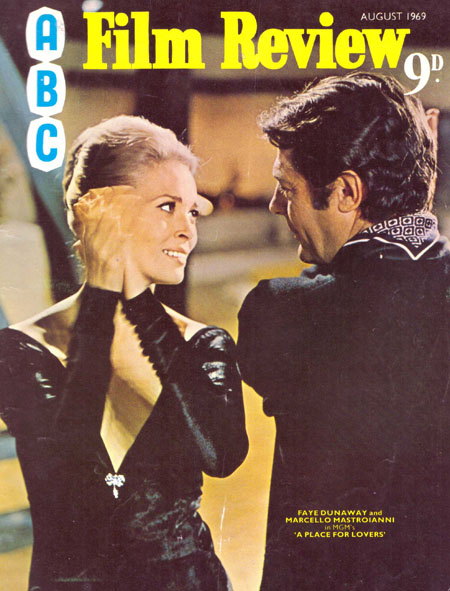
It may be understandable to think that the vast majority of major films have been released on home video but, in factthere are countless high profile titles that have yet to appear, or perhaps were once available but have gone out of circulation years ago. The unavailability of certain titles is generally due to either the lack of suitable master prints or rights problems. In either scenario, movie fans are deprived from seeing everything from genuine gems to guilty pleasures. Writing on his blog wwwthemagnificent60s.com, Cinema Retro contributing writer Brian Hannan focuses on one such "orphan" title, the 1968 production "A Place for Lovers". The film garnered few positive reviews and was met with a collective yawn by audiences despite the presence of screen legend Marcello Mastroianni and newly-minted star Faye Dunaway, fresh off her triumph in "Bonnie and Clyde". Adding to the prestige, the film was directed by the legendary Vittorio De Sica. Hannan points out that years ago film critic Harry Medved named the film as one of the 50 worst movies ever made, an opinion he takes issue with. In fact, Hannan argues that the movie has enough redeeming values to qualify for recommended viewing. Click here to read his review of the movie.
(Although "A Place for Lovers" is not available in the U.S. or U.K. on home video, it is presently streaming on YouTube.)
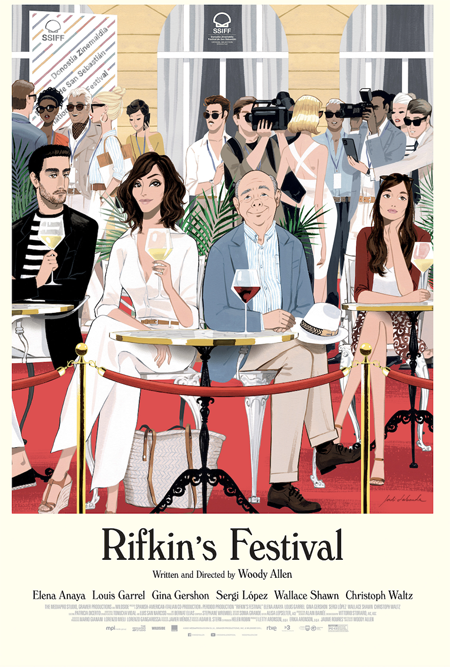
It bodes ill when a film opens with the lead
character sitting in his therapist's office complaining about something that
has happened in the very recent past. The viewer already has the feeling that
they missed something. That they're not in on a joke, a story, a fairy tale.
Catching up with the tale may be "Inconceivable!"Sorry. I just had to sneak that in. In
Rifkin's Festival the "annoying neurotic" is back.Here, not portrayed by Woody Allen in the
role but by great character actor Wallace Shawn (hence the "Princess
Bride" reference). He does the genre proud.
Reminiscent of "Manhattan", the
film centers around the relationship between Mort Rifkin (Wallace Shawn), a
failed novelist who pines over the days he was happiest - teaching cinema, and
the much younger, former student he's married to - Sue (Gina Gershon). The
action takes place at the San Sebastian Film Festival in Spain. Sue, a
publicist, represents a much-lauded French film director, Philippe (Louis
Garrel), who's new film is the talk of the festival. One can't help but think
about another Allen film "Stardust Memories" wherein Allen, as
director Sandy Bates, attends a retrospective festival of his films, complains
the whole time and has his hands full with multiple women and memories.
One of this film's problems was just
described. Much of what we see and hear we've heard before from this director.
I don't think there are many poor Woody Allen films but this just doesn't stand
up. The characters are caricatures. Philippe is a handsome, charming, shallow,
lothario. A reporter at the post- screening Q&A states: "There's a
rumor that you had an affair with the French Minister's wife." Philippe
replies: "I heard that same rumor, yea" to the laughter of the female
reporters.
Philippe and Mort do not get along. Mort
suspects his wife has a "crush" on her client. Mort is ignored during
the uncomfortable times the three spend together. Running into an acquaintance
at the festival, he discovers his wife lied to him about what she was doing and
was seen by the acquaintance walking on the beach with Philippe.
Eventually the stress scares Mort into
thinking he may be having a heart attack. Another acquaintance gives him the phone
number of a cardiologist and Mort makes an appointment. To Mort's surprise, Dr.
Jo Rojas turns out to be a gorgeous woman (Elena Anaya) whom Mort develops a
crush on. And off we go. He finds every excuse he can to get to the lovely
doctor's office and avoid his wife and Philippe.
Likeable characters here are few and far
between. It's a film festival; what's to be expected? An early scene when Sue
and Mort arrive in time for Philippe's post-screening Q&A is peppered with
quick bon mots such as this between a director and a lovely actress: "In
my new movie about the Eichmann trial you would be PERFECT to play Hanna
Arendt."Two gentlemen: "You
know tonight at eight o'clock there's a special screening of an old Three
Stooges movie. The director's cut." Female reporter to a porn star:
"In the movie were all your orgasms special effects?"
Philippe is asked by a besotted female
reporter: "...War is hell; and you came out and said it." To which the vapid director replies: "Well you
know, some wars are good and some wars are bad, and sometimes wars are
justified."When asked what his
next film will be he responds: "Well, in my next film I'm taking on the
turmoil in the Middle East... and, uh, (crossing his fingers) hopefully, uh,
offer some solution for reconciliation between the Arabs and Israel." Yikes!
Woody Allen hasn't lost his sense of irony or
his desire to tilt at the windmills of hypocrisy, deflate over inflated egos
and rage against the tripe that movie-goers will rave over. He's kind of
misplaced his through line however. Maybe, and I may be wrong, he's taking a
poke at all of today's blockbusters. With them there's barely a plot, no
subplot, only a couple of lines of dialogue to get to the violent (but
bloodless) action. Music video directors suddenly becoming the latest
"artiste" or "enfant terrible." Yes, MCU and DC, he's
aiming at you.
This film is predictable by half. However, there are some great moments; i.e.
when Dr. Jo gives Mort a tour of San Sebastian. Her car gets a flat. There's no
spare. They walk and hitch to the home/studio she shares with her philandering
artist husband Tomás (Enrique Arce) to catch him in in flagrante delicto with
one of his models. Arce's breakdown is a treat to watch.
Terrific performances in short roles and
scenes are offered up by Richard Kind and Nathalie Pozza as Mort's parents and
Christoph Walz as Death with a chessboard. Yea... Ingmar Berman makes an
appearance in another Woody Allen film. As I've related; we've seen a lot of
this stuff before.
Despite the film’s flaws, there are worse
ways to spend ninety minutes. Like most Woody Allen films, this is well cast
and well performed. In a case of life imitating art (or possibly the other way ‘round),
"Rifkin's Festival" was first screened at the San Sebastian Film
Festival in September of 2020 and released in Spain a few weeks later.
("Rifkin's Festival" will open in theaters and on-demand on January 28.)
(In light of Sidney Poiter's recent passing, we are re-running this article by Eve Goldberg that was originally posted in May, 2021.)
BY EVE GOLDBERG
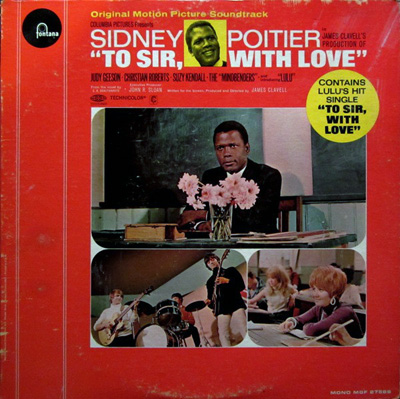
To Sir, With Love
(1967) is a classroom drama set in London’s working-class East End during the
swinging 1960s.It’s a well-scripted, well-acted,
and well-directed film of the “good teacher vs unruly students†subgenre.But, more than anything else, To Sir, With
Love is a Sidney Poitier film.It’s
Poitier’s persona and charisma, his decency and humanity, that shine through in
every scene.And, it’s Poitier at the
apex of his acting career—In the Heat of the Night and Guess Who’s
Coming to Dinner were also released that same year.The film has aged surprisingly well, and is
still enjoyable to watch.But it’s as an
artifact of the Sidney Poitier oeuvre that To Sir, With Love earns its historical
significance.
Class Struggle
In To Sir, With Love,
Poitier plays Mark Thackeray, an unemployed engineer who takes a job teaching in
a rough London high school while looking for work in his chosen field.From the beginning, the students give him a
hard time.Led by rebellious Bert Denham
(Christian Roberts), the teens are disrespectful and rude.Despite Thackeray’s patience, he fails to
reach them.Eventually, he ditches the
academic curricula and decides to engage the students around issues of personal
ethics, survival skills, and everyday reality. “Life, love, death, sex, marriage, rebellion—anything
you want,†he tells them.Thackeray
opens up about his own hard-scrabble childhood in British Guiana.He demands that the students treat him, and
each other, with respect.At one point,
he takes them on a field trip to a museum, which proves to be a breakthrough
scene as they experience life, and themselves, in a new way.
As the students grow and
change, new challenges emerge for Thackeray: a female student (pretty blonde Pamela,
played by Judy Geeson) develops a crush on him; he guides another student to
cope with a humiliating situation in a more mature way. Towards the end of the movie, the students
surprise Thackeray when they overcome their racism to attend the funeral of a
mixed-race classmate’s mother.
In Poitier’s own words, his
character “taught manners to kids who hadn’t understood what manners were… He
also taught about self-respect, dignity, integrity, and honesty… He taught them
integrity largely by showing them integrity.He offered himself as a friend, and until they were able to understand
the offer and accept it, he endured an awful lot.He was driven to anger.He was humiliated… In the end, though, he
succeeded in helping his students to see themselves in this new life as
valuable, useful human beings with impressive potential.â€
At the conclusion of the film,
Thackeray receives the engineering job offer he was hoping for.But he tears up the job offer letter,
realizing that he has found his calling as a teacher.
Race Takes a Back Seat
Despite several nods to issues
of racial prejudice—in addition to the funeral subplot, Thackeray must deal
with sporadic racists comments made by a fellow teacher and by the students—To
Sir, With Love is more about class than race.Thackeray is educated, sophisticated, of the
professional class and upwardly mobile.His students—almost all of them are white—are hard-core working-class,
aware that they face a bleak economic future.When Thackeray throws out the text books in favor of teaching practical life
lessons, he is in fact choosing to instruct the students in middle-class values
and behavior.
But for all that class
trumps race in this film, there is not a single moment when an American viewer
in 1967 would not have been acutely aware that this is a black man teaching
white kids.This is a black man counseling
a student to disavow violence and turn the other cheek.This is a black man who might or might not
become romantically involved with a white teacher.This is a black man who is intelligent, resourceful,
self-restrained, and kind.
And that was a big part of
the movie’s draw.
“I’m the only oneâ€
In 1967, Sidney Poitier was
the only black movie star in America.There
was no Will Smith.There was no Denzel
Washington.There was no Halle Berry, no
Eddie Murphy, no Viola Davis, no Jamie Foxx, no Angela Bassett.
In 1967, movies were still at
the center of the American cultural universe.When Newark and Detroit erupted in riots, when issues of race were daily
front page news, when the more radical factions of the civil rights movement were
verbally duking it out with the more moderate groups, Poitier was under
pressure to be a spokesperson for all of black America.
“I’m the only one,†Poitier
stated in an interview from that time.“I’m the only Negro actor who works with any degree of regularity.I represent 10,000,000 people in this
country, and millions more in Africa.â€
With the release of To
Sir, With Love, In the Heat of the Night, and Guess Who’s Coming
to Dinner, he also became the top-grossing box office star in the country.His ascent to this rarefied position was a
matter of talent, hard work, and the guts to take on challenges and risks.
Sidney Poitier’s life
journey began in 1927.He grew up on Cat
Island in the Bahamas, population 1,000.His parents were tomato farmers; their house had no electricity or
running water.He saw his first
automobile at age 10 when the family moved to Nassau.When he was 15, Poitier went to live with his
older brother in Miami.A year later, he
moved to New York where he worked as a dishwasher, took acting lessons, and
joined the American Negro Theater.A
fellow restaurant worker helped him improve his reading skills by pouring over
the daily newspaper together.
Eventually, the actor began
to get parts in theater, film, and television.His breakout movie role came in 1955 when he was cast as an angry,
rebellious student in Blackboard Jungle. From there, he went on to leading roles in The
Defiant Ones, A Raisin in the Sun, Lilies of the Field, and A
Patch of Blue.He was the first
black person to win a Best Actor Oscar—for his role in 1963’s Lilies of the
Field.
Poitier’s star was rising at
the exact time the civil rights movement was making its enormous impact on mainstream
America.He became active in the movement,
traveling to the south for Freedom Summer, and participating in Martin Luther
King, Jr.’s 1964 March on Washington.(Other stars who attended the march included Marlon Brando, Charlton
Heston, Paul Newman, and Burt Lancaster.)
As
an actor, Poitier became an icon in the struggle for racial equality.He refused to play roles that did not embody
dignity and strength. In an interview,
he described his relationship to the history of black people in cinema: “The kind of Negro played on the screen was
always negative, buffoons, clowns, shuffling butlers, really misfits.… I chose
not to be a party to the stereotyping … I want people to feel when they leave
the theatre that life and human beings are worthwhile. That is my only
philosophy about the pictures I do.â€
Fortunately
for Poitier, he was not the only one in Hollywood concerned with breaking these
old stereotypes.“The explanation for my
career,†he writes in his memoir, “was that I was instrumental for those few
filmmakers who had a social conscience.Men like Daryl Zanuck, Joe Mankiewicz, Stanley Kramer, the Mirisch
brothers, Ralph Nelson, Mike Frankovich, David Susskind—men who, in their
careers, felt called to address some of the issues of their day.â€
In 1966, Poitier was cast as
Virgil Tibbs, a Philadelphia police detective investigating a murder in a small
southern town, in Norman Jewison’s In The Heat of the Night.While waiting for production to begin, he traveled
to London to star in a modestly-budgeted film about a teacher and his students,
based on a property that had been kicking around Hollywood for years.
Iconic
To Sir, With Love
began as a 1959 autobiographical novel by Guyanese writer E.R. Braithwaite.Columbia Studios owned the film rights but
executives worried that it wouldn’t be a money-maker.They fretted that both its London setting and
its interracial romance between Thackeray and a white teacher would alienate
American audiences.So the book just
sat.
Eventually however,
Poitier’s agent Marty Baum put together a deal that offset the studio’s
concerns.
Baum was also the agent of writer
James Clavell (of later Shogun fame) who had scored a big success with his
book and movie King Rat.Clavell had
done a bit of screenwriting and directing and was eager to do more.He signed on as writer-director of To Sir,
With Love.Baum structured a deal in
which Poitier would get only a small up-front salary—much less than he would
normally command—plus 10% of the film’s gross earnings. Clavell agreed to work for a percentage of the
net.The film’s total budget would be
$640,000.By way of comparison, the
budget for In the Heat of the Night was $2,000,000 and Guess Who’s
Coming to Dinner’s budget was $4,000,000. Taking on only a minimal financial risk,
Columbia greenlit the film.
To Sir, With Love was
shot on location in London and at England’s Pinewood Studios.It was released in June, 1967, and quickly
became a smash hit. Studio executives
were surprised: they didn’t know that Poitier was such a huge box office draw.
Teenagers (including 13-year-old
yours truly) were among those who flocked to the movie.It had rebellious youth; it had Mod clothing,
rock music, and pop star Lulu’s catchy hit “To Sir, With Love.â€(Nineteen-year-old Lulu also has a part as
one of the students.) The title song
plays three times in the film, most notably as the soundtrack for an unusual scene
that sticks out in an otherwise conventionally styled move: The class field
trip to the museum is presented as a montage of still photos set to the title
tune (a slightly longer version than was heard on the radio or on the 45 RPM
record.)Is the montage a nod to hip,
avant garde filmmaking such as A Hard Days’ Night?Or was it a necessity due to the film’s
limited budget?Either way, it works.
Another plus for teenage
audiences is the school’s end-of-the-year dance at which live entertainment is
provided by real-life British rock band The Mindbenders.
But most of all, the movie
had Sidney Poitier.Who wouldn’t want a
teacher as handsome, understanding, compassionate, and smart as Mr. Thackeray?
Spurred by Lulu's bestselling single of the title song, the film's soundtrack became a hit, as well. It featured an extended cut of the song heard over the museum montage sequence.
Reviews of the movie were
mixed.
The New York Times’
Bosley Crowther called it, “a cozy, good-humored and unbelievable little tale
of a teacher getting acquainted with his pupils, implying but never stating
that it is nice for the races to live congenially together.â€
“If the hero of this
Pollyanna story were white, his pieties would have been whistled off the
screen,†Penelope Gilliatt wrote in The New Yorker.
Pauline Kael in The New
Republic—she had not moved to The New Yorker yet—was sympathetic to the
double bind Poitier found himself in: “Poitier has been playing the
ideal-boy-next-door-who-happens-to-be-black for so long that he’s always the
same…[but] What can he do?He can’t pass
as a white man in order to play rats or cowards or sons of bitches, and if he
plays Negro rats or cowards or sons of bitches he’ll be attacked for doing
Negroes harm.â€
The black press, which
generally applauded Poitier and his pioneering contributions to civil rights,
was mostly enthusiastic about To Sir, With Love.It was noted in Ebony, however, that
the book’s interracial romance between Thackeray and fellow teacher Gillian
Blanchard (Suzy Kendall) had been deleted in the movie.“Had Thackeray been white, the
Thackeray-Gillian relationship would have been a love affair.â€
Despite these mixed reviews,
the public kept buying tickets.Loads of
them.Month after month.Soon, To Sir, With Love became
Columbia’s biggest hit since Lawrence of Arabia.
Eclipsed
In the Heat of the Night
opened just two months after To Sir, With Love.Guess Who’s Coming to Dinner opened
several months after that.These latter
two films were prestige projects, centered around issues of race, with multiple
Academy Awards nominations and wins.All
three movies were giant box office hits.By any measure in Hollywood, 1967 had shaped up as The Year of Sidney
Poitier.
However, the peak of his
acting career was short-lived.Social
and political currents were shifting, and the tide turned amazingly quickly against
his film persona.
According to the actor, “The
issue boiled down to why I wasn’t more angry and confrontational.New voices were speaking for
African-Americans, and in new ways.Stokely Carmichael, H. Rap Brown, the Black Panthers.According to a certain taste that was coming
into ascendancy at the time, I was an ‘Uncle Tom,’ even a ‘house Negro,’ for
playing roles that were nonthreatening to white audiences, for playing the ‘noble
Negro’ who fulfills white liberal fantasies.In essence, I was being taken to tasks for playing exemplary human
beings.â€
Already in 1967, Poitier
sensed that his career as a leading man on screen was coming to an end.And he was right.He made more movies, as an actor and director—he
directed Uptown Saturday Night and Stir Crazy among others—but the
height of his cultural influence was over.
Today, Sidney Poitier may be
most remembered for his role as detective Virgil Tibbs in In The Heat of the
Night.But let’s not forget that it
was a little movie about a teacher and his students that launched the great
actor’s star into the stratosphere.
Eddy Murphy may or may not succeed in reviving his "Beverly Hills Cop" franchise, as he's long wanted to do. His recent comeback and surge in popularity might make his dream come true. In the meantime, the folks at the website www.digitalhollywood247.com look back on the three "Cop" feature films that have been released to date and evaluates their individual merits (or lack thereof). Click here to read.
CLICK HERE TO ORDER THE TRILOGY BLU-RAY COLLECTION FROM AMAZON
Writing on Crooked Marquee's web site, Roxana Hadadi pays tribute to the 1996 disaster film "Twister", which became a blockbuster despite the lack of big name boxoffice stars. The film appealed to those of us who enjoyed the spate of mega-budget disaster flicks of the 1970s- and "Twister" fully capitalized on the new generation of exciting special effects technology. Click here to read.
CLICK HERE TO ORDER BLU-RAY TRIPLE FEATURE ("TWISTER", "POSEIDON" AND "THE PERFECT STORM") FROM AMAZON
"Chisum", released in 1970, was John Wayne's first film after he won the coveted Best Actor Oscar for "True Grit", a fact played up in the trailer for the film which opened with news footage of Wayne exiting the Academy Awards ceremony, showing off the Oscar to an adoring crowd. The film was directed by Andrew V. McLaglen, who frequently collaborated with Wayne. This was arguably their best joint venture.
This review from the Independent Film Journal treats the movie like a standard John Wayne Western, but the uncredited writer fails to see the many factors that elevated it above most of Wayne's horse operas. In any event, the Duke had the last laugh when the ultimate film critic- the President of the United States- publicly praised the movie. Yup, Dick Nixon had screened it at the White House and told the press he very much enjoyed it. Not that Wayne needed presidential approval, as in 1970 he was still boxoffice gold- and indeed "Chisum" became one of his biggest hits. - Lee Pfeiffer
It's hard to believe that a half-century has gone by since the opening of director Gordon Parks' "Shaft" starring newcomer Richard Roundtree. The film's impact on the industry, pop culture and society was felt immediately and ushered in the era of the so-called Blaxploitation movies. Writing on the Digital Bits web site, Michael Coate provides a 4-page tribute to the film that contains some fascinating information and culminates on page 4 with a round table format discussion of the film's legacy with Cinema Retro's Lee Pfeiffer, author Josiah Howard and Chris Utley, who provides the viewpoint of a "Shaft" superfan. Click here to read.
Retro-Active: The Best from the Cinema Retro Archives.
By Harvey
Chartrand
Neville
Heath was an English killer
responsible for the murders of two young women. He was executed by hanging in
London in 1946 (aged 29). Heath was a handsome and well-spoken sociopath who
could easily lure women to their doom.
In 1967, Alfred Hitchcock was trying to rebound
from the failure of the Cold War espionage thriller Torn Curtain with an
original screenplay entitled Frenzy (and later Kaleidoscope). The
unproduced project was to have been based on the crimes of serial rapist-killer
Heath, although the story would be set in the present day in and around New
York City. The original story would be told completely from the point of view
of a murderer who is both attractive and vulnerable.
Screenwriter Benn Levy wrote in a letter to
Hitchcock in January 1967: “It's got to be (based on) Heath, not (John George) Haigh
(the acid bath murderer). Told forwards, the Heath story is a gift from heaven.
You'd start with a ‘straight’ romantic meeting, handsome young man, pretty
girl. Maybe he rescues her from the wild molestations of a drunken escort. ‘I
can't stand men who paw every girl they meet.’ Get us rooting for them both. He
perhaps unhappily married and therefore a model of screen-hero restraint. She begins
to find him irresistibly ‘just a little boy who can't cope with life’ -- least
of all with domestic problems such as he has described. She's sexually maternal
with him, she'd give him anything -- and we're delighted. Presently a few of us
get tiny stirrings of disquiet at the physical love-scenes but don't quite know
why. By the time we see the climax of his love in action and her murder, then
even the slowest of us get it! But we shouldn't know till then.â€
Rare trade ad for a film that was never made.
Frenzy would also be a stylistic
departure for Hitchcock. After watching Michelangelo Antonioni’s Blow-Up,
Hitchcock felt he had fallen behind the Italians in technique. Hitchcock
biographer Patrick McGilligan writes: “Watching one Antonioni, he sat up
straight at the sight of a man all in white in a white room. ‘White on white!’
he exclaimed to (his personal assistant and script supervisor) Peggy Robertson.
‘There, you see! It can be done!’â€
Hitchcock was also impressed
by the camerawork improvisation of maverick American director John Cassavetes (Shadows). He asked the novelist Howard
Fast (Spartacus, Cheyenne Autumn) to sketch a treatment about a gay, deformed serial
killer. Pleased with the results, Hitchcock composed a shot list with over 450
camera positions and shot an hour’s worth of experimental color tests, using
unknown actors in various states of undress. This footage was filmed in New
York City, and gives a tantalizing glimpse of what Hitchcock had in mind, of how
revolutionary Frenzy/Kaleidoscope would have been in his body
of work – a Psycho for the more
liberated counterculture era. Unfortunately, MCA/Universal were disgusted by
the script and test footage and immediately canceled the project, reducing
Hitchcock to tears. Hitchcock was coerced into directing Topaz, Leon Uris’ behind-the-scenes account of the breakup of a
Soviet spy ring at the highest levels of the French government during the 1962 Cuban
missile crisis. Topaz was another in
a string of artistic and commercial failures for Hitchcock as he approached age
70.
Japanese poster for the 1972 film Frenzy which was entirely different from the previous project Hitchcock had intended to use the title for.
What would have been
Hitchcock's most daring and controversial work was thwarted: an avant-garde
film using hand-held camerawork, a first-person viewpoint and natural lighting
(Ã la Blair Witch Project, filmed
32 years later), detailing the exploits of a gay bodybuilder who dabbles
in murder, rape and possibly necrophilia. It was conceived in 1964 as a prequel
to Hitchcock’s 1942 film Shadow of a Doubt and was initially titled Frenzy,
not to be confused with his eventual 1972 movie of the same name, from which
certain plot elements of the original Frenzy
were recycled.
Hitchcock’s interest in
Neville Heath first manifested itself in 1959 in his unproduced project No Bail for the Judge, which would have
starred Audrey Hepburn, Laurence Harvey and John Williams. A respected judge is
blamed for the murder of a prostitute, and his barrister daughter searches for
the real killer in London’s criminal demi-monde. Hepburn, who desperately
wanted to work with Hitchcock, suddenly withdrew from the project because of a
scene in which her character is brutally raped in Hyde Park by a good-looking London
pimp named Edward “Neddy-Boy†Devlin, who dominates Hepburn by
slowly strangling her with a necktie.
Audrey Hepburn never did work
with Hitchcock, but Laurence Harvey got along with the Master of Suspense and
starred in Arthur (1959), a grisly episode
of the long-running TV anthology series Alfred
Hitchcock Presents in which a beautiful woman (Hazel Court) meets with a
terrible fate.
Neville Heath
The rape scene in No Bail for the Judge obviously was one that Hitchcock wanted to
realize, in one form or another. It is quite similar to the scene of Mark’s
rape of the frigid Marnie on
their honeymoon cruise. The unproduced script of No Bail for the
Judge also looks forward to the unproduced Frenzy/Kaleidoscope
and to Hitchcock’s serial killer masterpiece Frenzy (1972), with its sexually impotent necktie strangler Bob
Rusk (Barry Foster) loose in London, eager to pin the murders of several
attractive women on his best friend. The unproduced Frenzy contains a
sequence in New York’s Central Park where the killer, Willie Cooper, takes a
young woman into the bushes and murders her. And while Bob Rusk may have more victims
to his credit than Neville Heath and Willie Cooper, it is clear that Edward
“Neddy-Boy†Devlin was Hitchcock’s first “necktie stranglerâ€.
So, as Hitchcock matured as an
artist, his impulse to film violent misogynistic scenes intensified – scenes
which would finally be free from censorship in the freewheeling “anything goesâ€
atmosphere of Hollywood in the sixties and seventies.
The Hustler (1961)
is a gritty, unsettling drama set in the seedy underbelly of the American
Dream. Produced, directed, and co-written by Robert Rossen, and starring Paul
Newman in one of his best performances, the film is a hard-edged gem in which
all the elements—writing, directing, acting, cinematography, set design,
editing, and music—are superb, and all the players are at the top of their
game.
On the Page — Origins
The Hustler began
as a short story, “The Best in the Country,†written by Walter Tevis and
published in Esquire in 1953. Tevis drew from his own experiences as a
pool hustler knocking around the dingy bars and pool halls of Lexington,
Kentucky. Later, he expanded the story into a novel—The Hustler—published
in 1959.
The book centers around Eddie
Felson, a small-time pool hustler with dreams of beating the best player in the
country, Minnesota Fats. He challenges Fats to a pool match and loses, then
dumps his longtime friend and manager, Charlie. In a desolate bus station he
meets Sarah, a crippled, alcoholic woman. Eddie and Sarah begin a relationship,
but it’s clear that she wants more from him than he wants to give. He also encounters
Bert, a gambler who recognizes Eddie’s talent, but calls him a “born loser.†Bert
offers to manage Eddie, teach him how to become a winner, and stake him to a
big-time pool hustle. Eddie turns down the deal because Bert’s percentage of
his winnings would be too high. Desperate for money, he goes to a bar in a rough
area of town to make some money hustling pool, but gets his thumbs broken by
some guys who don’t like being hustled. As Sarah nurses him back to heath,
their relationship deepens. After Eddie recovers, he accepts Bert’s offer and
they head out to the Kentucky Derby where he successfully hustles a rich
southern billiards player. He then beats Minnesota Fats in a re-match. At the
end of the book, Eddie’s fate is left in limbo: Will he continue his
relationship with Sarah? Or will his life be loveless like Bert’s, dedicated
only to winning at any cost?
Tevis’s novel was a popular success…and
Hollywood came calling. The property made its way around the movie industry; at
one point Frank Sinatra was attached, but that deal eventually dissolved. Then writer/director
Robert Rossen optioned the book.
Robert Rossen — Regret and
Redemption
Robert Rossen had a lot to
prove. His life, and especially his relationship to Hollywood, was complex and
troubled.
Rossen was raised on New
York’s Lower Eastside, the son of impoverished Russian-Jewish immigrants. As a
youth, he hustled pool and pinochle to get by. Eventually, he attended college
and became involved with radical-left theater during the Depression of the
1930s. Like thousand of other artists and progressives at that time, he also
joined the Communist Party.
Rossen broke into the movie
business as a writer. Under contract to Warner Brothers, his screenplays,
including Marked Woman and Dust Be My Destiny, were about tough
characters in a tough world. His depictions of gangsters, slums, and political
corruption were hard-hitting and street-wise, epitomizing the socially
conscious Warner Brothers’ style of the 1930s and 40s.
When the U.S. entered World
War II, Rossen helped mobilize Hollywood to assist in the war effort and fight
against the Nazis. After the war, he joined a picket line in front of Warner Brothers
Studio where laborers in the Conference of Studio Workers were striking. His
relationship with Warner’s was over. But his directing career, and the
gut-wrenching ethical dilemma that would shape the rest of his life and career,
was about to begin.
In 1947, the U.S.
Congressional House Un-American Activities Committee (HUAC), subpoenaed 19 Hollywood
writers, directors and producers, to testify about their political affiliations,
including their involvement in the Communist Party. Robert Rossen was among
them. The first ten to testify, including screenwriter Dalton Trumbo, stood on
their First Amendment right to freedom of association, and refused to answer
the Committee’s questions. All ten were sent to prison for Contempt of
Congress. They became known as The Hollywood 10. The eleventh person called to
testify was world-renowned poet and playwright Bertolt Brecht. Brecht sparred
with the Committee during a morning session, then boarded a plane for Europe
never to return to the United States again.
Hollywood luminaries,
including Humphrey Bogart, Judy Garland, and Lauren Bacall, rallied in support
of the Hollywood Ten. The HUAC hearings became a media circus, and the
Committee decided not to call the remaining eight to testify. Robert Rossen
went home.
The Hollywood 10, plus
several hundred others named as “subversives,†were blacklisted out of the
entertainment industry. Careers and lives were ruined. For the moment, Rossen
was spared. Right before the HUAC hearings, he had directed the noirish boxing
drama, Body and Soul. Now he went on to direct All the King’s Men
about corrupt Louisiana political boss, Huey Long. The movie won the Oscar for
Best Picture of 1949. By this time, Rossen had left the U.S. Communist Party,
unhappy with its connection to the repression and terror of Stalin’s Soviet
Union. But HUAC had not finished its work. In 1951, Rossen was again subpoenaed
to testify. He was questioned not only about his own political affiliations,
but was also asked to “name namesâ€â€”to snitch out other people. He refused to
name names and was blacklisted. His career came to a screeching halt.
Two years later, Rossen was once
again called to testify before HUAC. This time his desire to work trumped his
desire to do what he knew was right. He cooperated with the Committee, naming
57 people as Communists. Thanks to his cooperation with HUAC, Rossen revived
his career. But he spent the rest of his life justifying, defending, and being
eaten up inside by his decision to name names.
The Hustler is
one of only a handful of movies Rossen made following his HUAC testimony. In
it, he explores the themes closest to his heart—and his heartache: the
corrupting forces of capitalist society; human weakness; the emotional cost of selling
out.
While Rossen’s screenplay
for The Hustler remains essentially true to the novel’s plot and themes,
one major change darkens the mood, and drills down into its ultimate meaning:
In the movie, Sarah kills herself. Anguished by Bert’s cruelty towards her, her
self-destructive impulses win out. Right before her suicide, she writes in
lipstick on a bathroom wall: Twisted Perverted Crippled. Eddie is devastated by
her death. He continues on to defeat Minnesota Fats in their re-match, but it
has taken Sarah’s suicide for him to break free of Bert. To break free from the
win-at-any-cost mentality. He’s done selling out. He’s finally acquired
“character.â€
Rack ‘Em Up — Assembling the
Cast
As producer, director and
co-writer (with Sidney Carroll), Robert Rossen had control over all creative aspects
of The Hustler. He knew, however, that in order to obtain funding and
distribution for the movie, he would need a star.
At the time, Paul Newman was
coming up in the ranks of Hollywood actors. He had studied at the Actors’
Studio in New York and had the reputation as a kind of pretty-boy Brando. He
had acted on Broadway and television, and co-starred with Elizabeth Taylor in
the film version of Tennessee Williams’s Cat on a Hot Tin Roof. Then he
made Exodus. This big-budget production was not a great movie, and it
was widely recognized that Newman’s appeal was what made it a box-office
success. Paul Newman was now a top, bankable star.
Rossen believed that Newman
had just the right qualities to play cocky, good-looking, loser Fast Eddie
Felson. But the actor wasn’t available, already scheduled to star opposite Elizabeth
Taylor in Two for the Seesaw. Others were considered for the part,
including Bobby Darrin. Then Rossen got lucky. Taylor became sick and plans for
Two for the Seesaw fell apart. Rossen sent Newman his script for The
Hustler. “I read half of it,†the actor recalled, “and called my New York
agent at six o’clock in the morning and said, ‘Get me this film.’ And he did.â€
With Paul Newman on board,
Twentieth Century Fox agreed to put up the money and distribute. The movie was
a go.
Rossen’s casting of the
supporting roles is crucial to The Hustler’s quirky, dark vibe. The talent
and chemistry of the terrific cast is key to why it’s become a classic.
Piper Laurie was chosen to
play self-hating, alcoholic Sarah. She brings to the role a fragility and a yearning
to be loved that is painful to witness. She portrays Sarah as heartbreakingly vulnerable,
but also as someone with reserves of inner strength. When she limps, we see her
pride attempt to triumph over her self-loathing.
George C. Scott was cast as Bert,
the vicious gambler who vies with Sarah over Eddie’s soul. Like Newman, Scott
had cut his acting teeth on stage and television, transitioning to film in the
1950s. While he doesn’t possess Newman’s romantic-lead good looks, he radiates
power in all his roles. In The Hustler, Scott plays Bert as a man who
has sold his soul for money and wants Fast Eddie to follow down the same path. He’s
cruel and cunning; an astute judge of character and a master manipulator. As critic
Pauline Kael comments, “George C. Scott in The Hustler suggests the
personification of the power of money.â€
And finally there’s Jackie
Gleason. What inspired casting! Known primarily as a comedian, and especially
for his loudmouth bus driver Ralph Kramden on The Honeymooners, Gleason was
not an obvious choice. But he was the perfect choice.
Gleason’s Minnesota Fats is gracious
and regal. He’s an elegant dresser, ruling his shabby pool hall kingdom with a
fresh carnation in his lapel. He moves with the grace and fluid precision of a
dancer. He’s a man in control of his game. Unlike Fast Eddie, he knows when to
quit and cut his losses. Forty hours into their marathon pool match, with Eddie
slumped in a chair, drunk and exhausted, Gleason’s Fats genteelly freshens up
in the loo. There’s also a sadness in his eyes; he holds no illusions about the
life he’s chosen.
* Fun Fact: Minnesota Fats
was a wholly fictional character created by novelist Walter Tevis. After the
success of the film, an overweight New York pool hustler, Rudolf Walderone,
renamed himself Minnesota Fats. Walderone cashed in on his new identity with
book and TV deals, including a series of widely televised matches with
top-ranked pool professional, Willie Mosconi.
As important as the supporting
cast is, The Hustler is still Paul Newman’s movie. He has said in
interviews that he viewed Fast Eddie as a man trying to find himself, to
express his talents, to be a somebody instead of a nobody. Newman identified
strongly with Eddie’s struggle: “I spent the first thirty years of my life
looking for a way to explode. For me, apparently acting is that way.â€
Cinema Retro continues to shine the spotlight on worthy independent films.
BY GIACOMO SELLONI
Three pensioners in Rome find love where they
least expect it. In themselves.
Citizen of the World is a sweet and ultimate
touching story that centers around two old friends, now retired, collecting
their pensions that barely keep them afloat in expensive Rome, who discuss
leaving Italy to find a place where they can "live as kings" on their
measly pensions. Giorgio Colangeli plays
Giorgetto, a cantankerous ne'er do well who's rarely worked in his life and is
addicted to scratch off lottery tickets. He lives in a ramshackle apartment,
the bathroom of which is up a spiral, metal staircase. He allows a homeless
immigrant from Africa, Abu, (a sweet performance by first time actor Salih Saadin Khalid), to use his shower.
The director, Gianni Di Gregorio
(called Italy's "Larry David" for the films he makes that are about
nothing and everything) portrays Il Professore. A retired professor of Latin
and Greek, hes much of day in a little bar/cafe musing with Giorgetto about
their hard lives. He, at least, has a more hospitable abode. It's filled with
books, some rare.Giorgetto says he knows a guy who
moved to Santo Domingo and lives like a king. He doesn't actually know the guy,
but he 'knows' the guy's brother. He gets the brother's phone number and
arranges a meeting at the man's villa in Tor Tre Treste (a district of Rome
outside of the city walls) where they hope to question him and "get some
info." But a trip to Tor Tre Treste requires a long walk to a bus, to a
train and than another kilometer walk to find this villa, "the one with a
motorcycle in the yard." Here the meet Attilio (a
wonderful Ennio
Fantastichini), the jack-of-all-trades whose brother
lives in Terracina, a city on the coast, 56 kilometers south of Rome, not in
Santo Domingo. Attilio also dreams of leaving. He's traveled, whereas Il
Professore and Giorgetto have not. He has as many stories as Aesop and numerous
occupations. Now he sells and restores antique furniture. He, unlike his new
friends, does not receive a pension. But, he says he's thought about it and he
can leave if he wants; he's a "citizen of the world. I'm a free man!"
The entire story plays out over
the course of one week. We witness the ups and downs of planning where they
could go. On the advice of one of Attilio's clients (another professor) they
learn it must be a place with a good exchange rate, purchasing power, a stable
government, little chance of disease, natural hazards... Xenophobia could be a
problem; they'll be foreigners. You get the picture.
They need to come up with funds,
a float to get them on their way. They go about it in different ways. Do they
get it? Do they go to....? And what about Abu, the homeless immigrant?
Our three main characters gel and
spar with great chemistry. Also of note is Daphne Scoccia, who plays Attilio's,
free-spirited, beauty salon owning daughter, Fiorella.
One of the most touching parts of
this film has little to do with the script. Salih Saadin Khalid, in real life, was a
homeless migrant living in Rome. His pay from this film allowed him to join
what's left of his family in Canada.
Viewing this film has me interested in seeing
more of Di Gregorio's films and more of Ennio Fantastichini's work as well. He
passed away at the age of 63 in December of 2018 with 94 film credits in his
career.
I highly recommend traveling with these
citizens of the world.
We admire any critic who bravely defends the merits of a much-maligned film- and films don't get much more maligned than the ill-fated, often mocked 1996 remake of "The Island of Dr. Moreau" starring Marlon Brando in the most bizarre performance of his career. Writing for The Guardian, Zach Vasquez outlines the legendary production problems that contributed to the travails of completing the movie and he acknowledges its many shortcomings. However, Vasquez still sees some gold in them thar ruins and presents his case as to why the film has enough merits to recommend it for viewing. Click here to read.
Released
in 1971, ‘Red Sun’ is an enthralling Western starring Charles Bronson, Toshiro
Mifune, Alain Delon and Ursula Andress. Bronson and Delon lead a group of
bandits to rob a train, but get more than they bargained for as they discover
the train is transporting a Japanese delegation featuring Mifune, who is
guarding a priceless ceremonial sword, a gift from the Emperor of Japan meant
for the President of the United States. Delon steals the sword and leaves
co-conspirator Bronson for dead. Mifune and Bronson team up to make an unlikely
alliance in search of Delon and the stolen sword.
“For
the disgrace of failure, he will rip his abdomen and kill himself†roars the
Japanese ambassador as he tries to solder Link (Bronson) and Kuroda Jubei
(Mifune) into the unlikeliest good cop/bad cop routine you’re ever likely to
witness. “Well, that’s something I’d like to see!†retorts the eagled eyed,
moustached loner Link, who moments earlier had been left for dead after the
left-handed gun Gauche (Delon) fancied a bigger share of the riches from the
robbery.‘Red Sun’ may display many of
the conventional Western characteristics – robbery goes wrong and a manhunt
ensues – but its international flavour is unlike any other film of this genre
that’s been put on screen to date.
It’s
very rare that the co-lead of an American Western is a stoic Japanese sword and
sandal figure, but the very fact that Bronson and Mifune should appear on
screen together at all has more meaning than the average cinephile might think.
Mifune appeared in the 1954 classic ‘Seven Samurai’, directed by Akira Kurosawa
– and Bronson appeared in the Western remake ‘The Magnificent Seven’ directed
by John Sturges, who had recently enjoyed success with genre hits ‘Gunfight at
the O.K. Corral’, ‘The Law and Jake Wade’ and ‘Last Train from Gun Hill’. Both
Bronson and Mifune played their parts in two of the most influential films of
the era, so the fact that they appeared on screen together is significant. ‘Red
Sun’ is a totally original story that might have seemed too bizarre to succeed,
but given the two leads’ history, it’s a perfect film to showcase their
combined talents.
Director
Terence Young captures with ease the hostile and unforgiving landscape of the
tactile terrain (filmed in AndalucÃa, Spain), as Maurice Jarre’s musical score
transports you into the picture. Throughout Young’s filmography, ranging from
the early Bond films to his transition to Hollywood working with commanding
lead actors like Henry Fonda, Anthony Quinn and Lee Marvin, he gives
lower-budget B movies gravitas. (He had collaborated with Charles Bronson a few
years earlier on ‘The Valachi Papers’.) The plot of ‘Red Sun’ feels
deliberately engineered for Bronson and Mifune and has something of a fantasy
cast list. However, it never feels detached from reality and the resulting
consequences of the characters’ actions feel meaningful, even though on the
printed page, the scenarios might have appeared to be ludicrous.
Link
and Jubei are chalk and cheese; Bronson is witty and Mifune is much more
strait- laced, amusingly so when trying to comprehend the comedic dialogue just
served to him on a plate by Bronson. The most memorable scenes of film occur
when Link and Jubei are reluctantly travelling together in search of the
Japanese ambassador’s ceremonial sword as they squabble like children and
engage in some comedic faux fighting. Bronson’s character Link accompanies Jubei
to retrieve the ceremonial sword with his own agenda in mind. After being left
for dead by Gauche (Delon) and his men, Link aims to find his share of the
train robbery proceeds, but in order to do that he needs to find Gauche and
take him alive.However, Jubei wants him
dead due to the dishonour and trouble he’s caused. All of this reaches a
boiling point in the film’s final act. If you know your Bronson movies, you
know it’s never a good idea to leave him for dead…it’s just not going to end
well for the antagonist.
Legendary
director and actor John Huston claimed that ‘Red Sun’ was among the three best
Westerns ever made, alongside 1948’s ‘Red River’ and John Ford’s ‘Stagecoach’.
Huston certainly has an interesting take. Would ‘Red Sun’ finish anywhere my
own personal list of the top 10 Westerns ever made, let alone top three? No. I
enjoy the film very much and find it particularly re-watchable, as there’s
simply nothing else like it. Huston’s choice of placing ‘Red Sun’ on such a
high pedestal isn’t completel unworthy, however. It’s an inclusive Western,
well-loved in the genre’s fandom, but its appeal outside of that isn’t
extensive.
The
three main players involved in the project – Young, Bronson and Mifune – had
already produced their best work inside their respective filmographies. That
being said, ‘Red Sun’ still has a unique appeal over 50 years after its
theatrical release. Bronson has the same low-key magnetism that he displays in
mostl of his films whilst Mifune is suitably memorable as a samurai who finds
himself in the Old West.All the more
impressive about his performance is the fact that ‘Red Sun’ was his first
feature film role in the English language. (Where he has dialogue, at any
rate.) As for the rest of the main cast, Ursula Andress is commanding as
Cristina in what is the only main female character in the film. Although
Andress receives second billing, she doesn’t appear until an hour into the
film. That being said, Andress is worth the wait. She displays a certain
exterior swagger that is reminiscent of her breakout role as Honey Ryder in
‘Dr. No’ more than a decade previous. Alain Delon is every inch the perfect
villain as Gauche in his black attire, a dress code that could be compared with
that of Henry Fonda in ‘Once Upon a Time in the West’ or Jack Palance in
‘Shane’. Delon is just as likely to shoot someone down with his menacing blue
eyes as he is with his pistol, as he’s an outlaw with no ethical compass.
‘Red
Sun’ is the pinnacle of the Eastern/Western crossover and has to be seen to be
believed.
Released in 1972, The Valachi Papers depicts the rise and
fall of Mafia informant Joseph Valachi, who became the first member of the
Mafia (otherwise known as Cosa Nostra) to acknowledge its existence in public.
Directed by Terence Young (Dr. No, From Russia with Love, Thunderball) and produced by legendary
Italian film producer Dino De Laurentiis The
Valachi Papers stars Charles Bronson in the lead role, alongside his
real-life wife Jill Ireland as well as Lino Ventura, Walter Chiari and Joseph
Wiseman.
The film covers five
decades of Valachi’s involvement in organised crime – from his burglaries with
the Minutemen to working under mob boss Vito Genovese from the 1930s – as the
film unceremoniously portrays life in the criminal underworld. Told from the
perspective of Valachi, the film begins with the ageing gangster in prison
fearing for his life after a contract for his killing is ordered by Don Vito
Genovese (Lino Ventura), who suspects him of betraying the Family. Determined
not to be silenced behind bars and avoid an inside hit, Valachi co-operates
with the U.S. Justice Department – unveiling the secrets of life in the Mafia
as the film follows Bronson’s on-screen Joe Valachi through voice-over and
flashback sequences.
The film is based on the
biographical book of the same name, written by Peter Maas in 1968. Nearly five
decades after the movie’s release, it’s difficult to truly comprehend the anticipation
surrounding a Hollywood picture based on Joseph Valachi’s tell-all testimony to
the FBI that was televised across the United States in 1963. Never before had
the public, or indeed the FBI, really been aware of the true extent to which
organised crime functioned in America. Valachi - who had been a former Mafia
‘soldier’ in the Genovese crime family – disclosed that the Mafia was called
‘Cosa Nostra’ in Italian – translating as “this thing of ours†in English.
Valachi’s public testimony divulged the structure of the Mafia, from its
hierarchy to the Five Families in New York City. This incredible true story was
always going to have golden Hollywood potential when being made into a motion
picture, but there would be two competing Mafia movies in 1972. One became widely
regarded as one of the best films ever made and the other would disappear from
popular culture…
Perhaps, The Valachi Papers is worthy of a
reappraisal in the modern era. Sure, there are some clunky edits that also
plagued director Terence Young’s early James Bond films – although they are
simply too good to care – and the jolty dubbing of certain supporting actors
also fails to go unnoticed. That being said, it’s to the film’s credit that you
can overlook its flaws, that the story and performances are simply too good to
worry about a few minor things that don’t hold up well fifty years later.
Charles Bronson starred in The Valachi
Papers at a time when he was finally achieving major international stardom.
Having enjoyed success in ensemble pieces in a supporting capacity – The Magnificent Seven, The Great Escape and The Dirty Dozen – Bronson made his name
as a leading man in Sergio Leone’s epic spaghetti western, Once Upon a Time in the West opposite Henry Fonda, Claudia
Cardinale and Jason Robards. The Valachi
Papers would be Young and Bronson’s third and final collaboration together
after Cold Sweat and Red Sun. As Bronson’s popularity as a
leading man grew, he would carry forward his tough guy persona under director Michael Winner as vigilante
Paul Kersey in the Death Wish series,
among other collaborations with Winner.
There’s an argument to be
made that Bronson’s performance as Joseph Valachi is the most versatile
performance of his entire career. Bronson emits his trademark softly spoken
innocence packaged with his menacing cats’ eyes that tell a thousand words when
no dialogue is offered, which in itself is a contradiction in terms. Yet
Bronson’s appearance changes more in this movie than in any of his others
combined. He’s convincing as Valachi in young, middle and old age – long before
the days of CGI and de-aging techniques. From the colour of his hair to the
speed at which he moves, Bronson is totally believable as Joe Valachi, which alone
makes the film worth seeing. It’s Bronson who makes the film tick, as the
narrative jumps back and forth through time – a comparison that you can make
with Martin Scorsese’s The Irishman. As
good as he is, Lino Ventura doesn’t have the same on-screen magnetism as Marlon
Brando’s Don Corleone. Perhaps the author of ‘The Godfather’, Mario Puzo,based
Don Vito Corleone on the real-life Vito Genovese? Puzo certainly drew on the
real Valachi Papers for his best-selling book that was adapted for the screen
by Francis Ford Coppola.
Indeed, The Valachi Papers lacks the all-round
spectacle, pomp and grandeur than that of The
Godfather. It’s not difficult to analyse why The Godfather was so successful. Hoping to ride the wave of The Godfather’s success – The Valachi Papers bombed commercially –
critically shunned as inferior. Director Terence Young said of The Godfather: “It is the most expensive
trailer ever made – a trailer for our film! We are really much closer to The French Connection. We are the other
side of that coin – you could call us ‘The Italian Connection’!â€
Comparable with The Godfather, The Valachi Papers does feel like an old movie – it’s not a
criticism, but it’s overshadowed by Coppola’s timeless classic. With the
exception of Bronson, there isn’t an all-star cast with multiple Academy Awards
between them or an array of quotable lines. The best we get is delivered by
Joseph Wiseman who’s best known as Dr. No in the film of the same name: “We
cannot bring back the dead, only kill the living.â€
The Valachi Papers
ultimately failed. Failed because it was immediately compared with The Godfather. How could it win? It has
a stripped-down sensibility – The
Irishman meets Goodfellas but on
a tenth of the budget. It’s not a masterpiece, but with Charles Bronson giving
a career best performance – The Valachi
Papers is a forgotten gem in need of a polish.
(Readers are invited to share their thoughts with Matt Davey at 4davem12@solent.ac.uk )
CLICK HERE TO ORDER BLU-RAY FROM AMAZON USA (Includes "Breakout", "Hard Times" and "The Stone Killer").
Critic J. Hoberman reflects on the cinematic and societal impact of George Romero's seminal indie horror classic "Night of the Living Dead", which was released in that tumultuous year of 1968. (Yes, folks there actually was a more tumultuous year than the crazed election era of 2020.). The Vietnam War was raging, protests were ongoing, cities were burning and two of the most important men of the era- Martin Luther King, Jr. and Bobby Kennedy- were assassinated within a span of two months. Fittingly, Romero's groundbreaking horror flick tossed aside all conventions. There was no happy ending, a black man was the hero and we were all made aware of how fragile the solidity of civilized society actually was. We survived all that and we may well survive the calamity of our era of Coronvirus, crazed political leaders and the rise of fringe hate groups. But now, more than ever, Romero's cheapo horror masterpiece seems to speak to our era in way we haven't experienced since the year it was released. Click here to read. - Lee Pfeiffer
CLICK HERE TO ORDER CRITERION BLU-RAY SPECIAL EDITION FROM AMAZON
Australia during COVID is largely a nation in
lockdown, some States worse than others, with State borders closed to travel,
or exemptive paperwork checked as you cross. The national death toll has now
exceeded 700, and the State that has suffered most is Victoria. The comedian Ross
Noble has commented that Australia is currently like a Spice Girls reunion –
everyone’s trying really hard, but Victoria keeps letting us down. Ouch…
The capital of Victoria is Melbourne, the one Australian
city that rivals Sydney in size and appeal, and probably exceeds it in
cosmopolitanism. With the city under curfew, the newspapers daily feature
disturbing photographs of the streets standing empty and bleak. The images
suggest the end of the world, but Melbourne has already been there. In the
movies.
These same streets were rendered deserted once before …by
Hollywood…for the filming of Stanley Kramer’s apocalyptic movie “On the Beachâ€
in 1959. The contemporary newspaper shots bear a chilly resemblance to the
production stills from that film. Did Hollywood get it right again? Was Stanley
Kramer more prescient than he could ever have believed?
A final shot in the movie - again filmed in a
Melbourne Street, outside the Victorian Parliament House from where today the
Premier fights a valiant battle against COVID - features a Salvation Army banner
reading “THERE IS STILL TIME…BROTHERâ€; while the usual overblown publicity
called it “The Biggest Story of Our Timeâ€, warning that “If you never see
another motion picture in your life, you MUST see ‘On the Beach’.†For once,
was the hyperbole deserved? Double Nobel prize-winning scientist Linus Pauling
said: “It may be that some years from now we can look back and say that ‘On the
Beach’ is the movie that saved the worldâ€. That’s some commendation.
Kramer was big on messages: “High Noonâ€, “Judgement at
Nurembergâ€, “Inherit the Windâ€, “Ship of Foolsâ€, “The Defiant Onesâ€, “Guess
Who’s Coming to Dinner†– yes, it’s a mad, mad, mad, mad world. “On the Beachâ€
was another of Kramer’s warnings, a more than appropriate one at a time when
the Cuban Missile Crisis was just around the corner.
“On the Beach†is a movie depicting the last days of a
dying world; dying from fallout caused by a nuclear war in the Northern Hemisphere.
It seems that some “horrible misunderstanding†launched such a war. “Fail Safeâ€
and “Dr Strangelove†were still to come; horrible misunderstandings, it seems,
were to become de rigueur as a means of triggering an apocalypse. After all, how
else would a nuclear war begin? Life in the North has largely disappeared. The
Antipodes have been untouched by the actual war, but guess what, folks…the
radiation is on the way, and death is inevitable. Hence those damning empty
streets, once cleared for filming, now eerily empty for real.
“On the Beach†was based on a novel by Nevil Shute
published in 1957. Shute was a British engineer who worked on the first British
airship and helped the Royal Navy develop experimental weapons for D-Day.
Following the old story of the insider being the one to see the dangers, he
soon began to warn the post-war world of the proliferation of nuclear weapons.
The scientist in the movie…one Mr Fred Astaire…yes, that one…explains: “The
devices outgrew us. We couldn’t control them. I know. I helped build them, God
help me.†The novel is prefaced by the now-familiar T.S. Eliot quote: “This is
the way the world ends…not with a bang but a whimperâ€. The theme, it seems, was
self-evident after that.
Shute had started writing adventure novels at night,
and was extremely prolific. While his style was highly criticised, he was a
top-selling author for some decades, remembering this is the era of such
prosaic but successful authors as Alistair MacLean. “On the Beach†is said to
have sold over four million copies world-wide, and is reputed to have knocked
“Peyton Place†from Number One sales position in the U.S. How did that happen?
Critic Gideon Haigh claims that with this novel “Shute had published arguably
Australia’s most important novel…confronting (an) international audience to the
possibility of…thermonuclear extinctionâ€. So what’s the Australian connection?
Post-war, Nevil Shute had visited Australia and saw in
it a place of greater refuge perhaps than war-torn Europe. He moved with his family
to Melbourne and proceeded apace with his literary career. Another best-seller
of Shute’s was “A Town Like Aliceâ€, the town being Alice Springs in the
Northern Territory. This was filmed in 1956 starring Virginia McKenna and Aussie
Peter Finch, and re-made as a television mini-series in 1981 with Bryan Brown
and Helen Morse. Incidentally, Bryan Brown also starred, along with his wife Rachel
Ward and Armand Assante (in the lead role), in the 2000 television series of
“On the Beachâ€. Brown played the Fred Astaire role of the scientist!
Kramer had a number of problems getting “On the Beachâ€
to the screen, not the least of which was Nevil Shute who disowned the
soft-soaping of such an important theme, and the immorality of the screenplay
with its suggestion of adultery. United Artists also saw problems, requiring
the film to be tamed for wider public consumption. There was, after all,
explicit reference to euthanasia as a major plot element, and though radiation
was the killer here, the film certainly avoids anything like nasty blistering
and any other physical deformity. The U.S. Navy was in no mood to supply the
nuclear submarine required for the film. A British diesel sub, HMS Andrew, on
loan to the Australian Navy, was dressed up for the part, while the Australian
Navy had no problem with allowing filming on board the aircraft carrier HMAS
Melbourne.
Nowadays,
for those of us in comfortable circumstances, traveling to remote, exotic
shores is no big deal.All you need are
a credit card and a reservation at Sandals.If you’re especially eager to shed the daily grind, you’ll even take the
chance of sitting in planes and terminals for hours among scores of strangers,
any of whom may be carrying the COVID-19 virus.(Rest assured, they’ll be equally wary of you.)If you prefer to ride out the pandemic,
Tahiti and Waikiki will still be waiting.In the 1930s and early ‘40s, such luxury was beyond the reach of the
average wage-earner.They had to make do
with a night at the local movie house, where they could vicariously spend time
in Polynesia -- or at least Hollywood’s version, sometimes in Technicolor --
for the price of admission.Usually,
these films were built around stories on the pulp-fiction level of beautiful
Island princesses in sarongs, tribal revolts, volcanic eruptions, and seafaring
heroes, but a few sneaked in more subversive, troubling themes of tropical
paradises despoiled by western greed and disease.One such was Paramount Pictures‘ 1937
production, “Ebb Tide,â€based on a novel
by Robert Louis Stevenson and his stepson, Lloyd Osborne.Never released by Paramount on home video,
“Ebb Tide†used to appear occasionally on local TV stations before Late Shows
were edged out by Jack Paar, Johnny Carson, and their successors, but it’s been
largely missing in action in the decades since then. Most people now will identify “Ebb
Tide,†if at all, with the dramatic ballad of the same name, best-remembered
from the 1965 recording by the Righteous Brothers.Ironically, the song was written in 1953 and
has nothing to do with the movie.
In
the Paramount film, Herrick (Ray Milland), Therbecke (Oscar Homolka), and Huish
(Barry Fitzgerald) are three jailbirds in 1890s Tahiti.Herrick is cultured but chronically down on
his luck, Therbecke a disgraced ship’s captain, and Huish a jovial but devious
alcoholic.Stevenson modeled the
characters on real-life drifters and outcasts whom he encountered in the
Pacific islands in the final, far-traveled years of his life.The trio’s aimless existence is disrupted
when a schooner comes into port from San Francisco, bound for Australia with a
cargo of champagne.The captain and the
first mate have died from smallpox, leaving the ship stranded.The authorities try to recruit a captain to
deliver the vessel to its ultimate destination, but fearing that the ship
remains infected, the reputable skippers in town decline to sign on.As a last resort, Therbecke is offered the
job and accepts, appointing Herrick as first mate and Huish as ship’s
steward.Neither man has any maritime
experience, but that doesn’t matter to Therbecke, who doesn’t intend to
complete the assignment anyway.Given an
unexpected opportunity to profit from others’ misfortune, he plans to divert
the ship to Peru, sell its cargo, and pocket the money.
Once
at sea, he makes two unwelcome discoveries.The first is the late captain’s daughter, Faith (Francis Farmer), who
comes out of hiding and insists that Herbecke fulfill her late father’s
obligation.The second discovery is that
the cargo is much less valuable than it appeared to be.Most of the champagne bottles are filled with
water.The late captain, as unscrupulous
as Herbecke, had secretly planned to sink the schooner at sea and collect the
insurance on the invoiced cases of “champagne.â€After a storm blows the ship off course, the three partners come across
an island controlled by an American expatriate, Attwater (Lloyd Nolan), who
lives in an elegant bungalow.In short
course, they discover that Attwater is a soft-spoken but trigger-happy
religious zealot who used slave labor to illegally harvest pearls, which now
fill his storehouse.The theme of
epidemic disease reenters, one with its own resonance today.Smallpox has swept through the island and
most of the native laborers have died, leaving only Attwater and three
household servants.“That’s why the
house is empty and the graveyard is full,†he says matter-of-factly.Herrick’s conscience reawakens, and he wants
to get Faith off the island and home to safety.Herbecke and Huish meanwhile conspire to dispose of Attwater and steal
his pearls.Homolka, Nolan, and
especially Fitzgerald are excellent in dark roles that cast all three veteran
actors against type.
The
screenplay makes one concession to formula by adding a new, pivotal character
to Stevenson’s original, all-male story, Francis Farmer’s Faith.Faith provides a conventional love interest
(and eventually, redemption) for Ray Milland’s Herrick.Otherwise, the script follows the bleak novel
almost scene for scene and line for line.This alone should encourage fans of classic fiction and literate scripts
to give “Ebb Tide†a respectful look, not to mention film noir enthusiasts who
will embrace the movie’s morally bankrupt characters, inescapable reversals of
fortune, and pervasive deceptions and betrayals.Unfortunately, mainstream critics and
prospective audiences are unlikely to check out the film since a good, officially
authorized edition doesn’t exist on home video, Netflix, or Amazon.The chances of Paramount stepping up seem
remote to none, given the studio’s apparent indifference to releasing or
licensing the bulk of its older catalog on DVD and Blu-ray.For that matter, has the studio even preserved
the needed elements from which a hi-def print could be digitized, restoring the
“breath-taking Technicolor†promised in Paramount’s 1937 ads and press
book?In the meantime, for the curious,
copies are available on the collector’s market and You Tube.
Apparently
several generations removed from the original prints, they’re watchable but
less than optimal.But they’re what we
have.The YouTube print is posted at https://www.youtube.com/watch?v=fk6icHLkzl0.
(Fred Blosser is the author of "Sons of Ringo: The Great Spaghetti Western Heroes". Click here to order from Amazon)
The United States of America brought to the world many
amazing things. To this reviewer the top three are baseball, jazz and comic
books, although I must admit I prefer comic books to jazz. Let's face facts
here, whether you love, despise, or are just 'eh' about comic books they are
among the very first things that children read. I loved them before I could
read. Consider that a disclaimer for the review about to follow.
Anthony Desiato is a life-long (so far) comic book fan,
podcaster and documentary filmmaker from Westchester County in New York. His
company is called Flat Squirrel Productions. In 2017, through Kickstarter, he
reached his goal of $15,000 to make the film he promised "will take you
behind the scenes and capture the business, culture, and fandom of the local
comic book store on a national level." He succeeded with the release of
"My Comic Shop Country". This film is a wonderfully interesting look
at the strange and familial world the industry has created, and now, is
possibly destroying. It hit home with me on a number of levels but more about
that later. For now, some history.
Comic books have traveled a rough road from their
beginnings. In 1933, Eastern Publications published what is regarded as the
first newsstand comic book in the format we know today, "Famous Funnies a
Carnival of Comics" which was basically combined newspaper strip reprints
with some original material. It started the industry. Eastern, and later Dell,
began to publish these on a regular (bi-monthly basis). Ron Goulart (comic book
historian and terrific novelist in his own right - read his Groucho Marx
mysteries series) called this publication: "the cornerstone for one of the
most lucrative branches of magazine publishing."
Five years later, two young men in Cleveland, Ohio
created (based somewhat upon Edgar Rice Burroughs' “John Carter, Man of Marsâ€)
a character that would change not only the industry but the world. Of course,
most of you know I mean Superman. Arguably the second most famous fictional
character in world history behind only Sherlock Holmes. The following year saw
the introduction of Batman. Timely Comics (which would eventually become
Marvel) also first appeared in 1939.
The comic book industry flourished. Romance, Westerns,
horror, anthropomorphic animals. Nothing was left out. For more than fifteen years
the industry grew not only in size but in pushing boundaries. Realizing that
most of their readers were teen-aged boys, comics started to feed their
adolescent...
well you know what I mean. Scantily clad women appeared
everywhere. From femme fatales to heroines, supporting characters to characters
who didn't wear support garments, pubescent fantasies were fulfilled. According
to a wacko psychiatrist named Fredric Wertham, who in 1954 published the book
"Seduction of the Innocent," claimed "that comic books were
responsible for an increase in juvenile delinquency, as well as potential
influence on a child's sexuality and morals." That led to the Senate
Committee on Juvenile Delinquency to investigate comics. Like parents
throughout eternity, Senators didn't have any idea what their children were
reading (well, maybe a dad or two did) and in an effort to hold off a
government response that would censor their industry, the Comic Code Authority
was formed and all comics had to pass through a censorship inspection. The Code
lasted into the 70s and was abolished formally in 2011.
"And now... back to our film"
Now that the Comic Book Ignorant (further referred to as
the CBI) have been brought up to speed on comic book history let me enlighten
you about the film.
Obviously, a labor of both love and regret for Desiato,
“My Comic Shop Country†stands out as an indictment against greed,
monopolization and poor manners. He was a regular customer, loiterer and
sometime employee of a comic shop called Alternate Realities in Scarsdale, NY.
He later became a podcaster. His shows discuss the comic book industry and life
in Westchester. A previous documentary, "My Comic Shop Documentary,"
made in 2011, was all about Alternate Realities and its owner, Steve Oto. For
this new film, Desiato visited twenty comic shops in nine states across the US
and built relationships with the owners.
The first dedicated comic book shop opened in the late
60s in Southern California. The direct market industry started to grow as the
dedicated comic shop industry grew. By the 90s there were over 12,000 in the
United States.
If the CBI don't know, there is a difference between
direct market distribution and the traditional newsstand distribution that
those of us of a certain age grew up with. The direct market in the 70s and 80s
allowed for independent comic book companies to distribute more adult fare. But
as things grew with more independent publishers such as First Comics, Capital
Comics, Pacific Comics, The Guild, Image Comics, etc., they began to flood the
market distributing the books themselves. But they also paid the creators fair
wages as opposed to the work-for-hire system that had existed for generations.
Famous comic book artists such as Jack Kirby, Frank Brunner, Howard Chaykin,
Neal Adams began to create content for these companies where the creators
retained licensing rights for their characters. Glut became an operative word.
Too much of a mediocre thing. As the smaller of these small companies died out,
so did the distribution channels. Eventually, distribution would become a
monopolistic ouroboros - the snake that eats itself.
In today's industry, direct shops must order books from
Diamond Comics Distributors' (the monopoly) Previews catalogue two months in
advance of shipping. In the 90s, Previews was published not by a monopoly but
by a company intent on spreading the word, thank Rao, (CBI, please web search)
and the catalogue was magazine thickness. Today, run by the existent monopoly,
its size is somewhere between a Montgomery Ward Christmas Catalogue and a
pre-cellphone Yellow Pages. And, unlike in newsstand, bookstore, luncheonette,
etc. distribution, the excess books cannot be returned. When I collected comics
as a child all the newsstand, et. al., had to do was return the torn corner of
the cover that held the price to receive a refund on the unsold books that sold
at the time for 12 cents. The store then sold them for a few pennies. I have
some books in my collection that are thusly marred. Direct market shops have to
eat the leftovers. Hence, the very large back-issue sections.
“My Comic Shop Country†is filled with colorful
characters. From the denizens who haunt the shops to some of the creators
themselves, Desaito discusses the state of the industry with all. It was a great
pleasure to meet these fellow geeks. Then again, everyone is a geek of some
order. Jocks are sports geeks, no?
Paul Levitz, former President and Publisher of DC comics:
"85% to 90% of the shops are mom and pop stores. Brick and mortar is not
at a great time in America today." "If you own a bake shop the
quality of the shop is up to you. If you run a comic shop the quality of the
shop is up to other people."
Sarah Titus, co-owner, The Comic Book Shop (Wilmington,
DE): "How do you have a million dollar comic book shop? You start with two
million dollars…When someone calls us a Comic Book Store, I say, "No, a
STORE is where you go to get, like, toilet paper. A SHOP is where you go to
look at all the cool things, and compare, and check, and take it all in." Has
there ever been a clearer dictionary definition between the two?
The transgressive effect of Crash
is immediate since the film opens with three sex scenes in succession.
Cronenberg observed the effect first hand at test screenings:
There are moments when audiences burst out laughing, either in
disbelief or exasperation. They can't believe that they're going to have to
look at another sex scene . . . In one of my little test screenings
someone said, "A series of sex scenes is not a plot." And I said,
"Why not? Who says?" . . . And the answer is that it can be,
but not when the sex scenes are the normal kind of sex scenes . . . Those can
be cut out and not change the plot or characters one iota. In Crash,
very often the sex scenes are absolutely the plot and character
development.[i]
The aberrant sex depicted in those many
scenes that drive the narrative, adultery, cuckoldry and other such instances
of polymorphous perversity, is inherently transgressive. To achieve the
transgressive kinetics of those scenes Cronenberg relied on an exceptional troupe
of intellectually engaged actors, among them Deborah Kara Unger, who admitted to
her own transgressive experience with the film in her role as Catherine
Ballard, “When David Cronenberg sent me his script . . . I was shocked, taken
aback, absolutely altered by it – and unprepared for that alteration . . .undeniably
the script impacted me and changed me.â€[ii]
Perhaps the best way to conceptualize Cronenberg's cinematic coups de main
is as a cult rite of passage the viewer must pass through to earn one's
"ticket to ride" in the vehicle known as Crash.
Crash is set in what appears to be the late
20th century North American urban center of magnificent high-rise
enclaves and overstimulated existence. Catherine and James Ballard (James
Spader) are the upper-middle class thirty-something couple of the not too
distant future who delight in sharing the intimate details of their
extramarital exploits. However even this arrangement does not fully satisfy
them since neither Catherine nor James climax during their encounters; "Maybe
the next one . . . " is their household refrain. On one late night commute
down a rain-swept road James loses control of his car and collides head-on with
a vehicle driven by Dr. Helen Remington (Holly Hunter). Their crash effects an
intellectual awakening in both of them to the potential of enhanced erotic
experience. She puts him in contact with Vaughan (Elias Koteas), former
specialist in international computerized traffic systems, now the creative
intelligence behind a car crash cult. Other cult members include Colin Seagrave
(Peter MacNeill) active in the staging of celebrity car crash reenactments and Gabrielle
(Rosanna Arquette) a permanently debilitated car crash survivor in
steel-reinforced leg and hip braces. Crash becomes the journey of James
down the road of discovery in search of a new form of ecstasy that may provide
some vitality to his otherwise disconnected and passionless existence.
Originally released in Germany in 2018, “Intrigo: Death of An Author†recently made
its way to U.S. screens. A twisty,
psychological thriller with multiple story lines, deftly directed by Daniel
Alfredson (of “The Girl Who Played with Fire and The Girl Who Kicked the
Hornet's Nestâ€) has almost as many turns as Lombard Street and is just as fun
to navigate.
The film opens with a small motorboat
puttering in the sea at night. From under the waterline we see a heavy object is
dropped with a rope attached. The sky above fades darker then brightens with
the morning sun and the scene cuts to a lone man walking along a rocky shore.
The narrator says:
The
people of the world are more or less the same. Though we may come in different
shapes
and colors we all share the same inheritance and we all have our back stories
and
our secrets. Like this man, let's call him Henry, trying to find his way on a
remote
Greek
island. Even though Evolution might seem to adjure us, there are still parts of
our
brain that belong to our reptile ancestors. Although we have convinced
ourselves
that
Hate, Revenge and Nemesis belong to the past, our ancient ancestor's blood
still
runs
in our veins. Whether we like it; or not.
Henry Martins (played with a magician's
misdirection by Benno Fürmann) has come, with much difficulty, to this remote
island to meet with the famous, reclusive author, Alex Henderson (a
delightfully wily Ben Kingsley) who appears to be the island's sole inhabitant.
MARTINS:
A lighthouse. That's quite something.
HENDERSON:I like to guide people. If they get too close
I turn the light off.
Martins' mission is to get Henderson's advice
on a story he is writing. Is it 'good or interesting enough?' as there are
parallels to one of Henderson's previous novels. He begins to read a bit to
Henderson.
The story is about a couple, David and Eva
Schwartz, who have been married almost eight years. They are on a trip to the
Austrian Alps to ostensibly work on their relationship. It's obvious that there
are problems. At the scenic lodge where they are staying we are illuminated to
the problems and learn that Eva has been having an affair and plans to leave
David. We also learn that her lover is staying in the next valley to her and
David. So does David. He hatches a plan. He tests the road to the next valley
himself and finds that brakes are unnecessary until there's a twisty, steep
downhill road to take. As you're probably guessing, he disconnects the brakes
and on Eva's next trip to Infidelityville...Well, she never returns to the lodge.David is a suspect in Eva's (a perfectly aloof Tuva Novotny)
disappearance but without a trace of the car, a body or even a witness...
HENDERSON:So. This is the end of your story. You must
be joking.
MARTINS:It's actually the beginning.
Henry Martins continues his story. Three and
a half years pass. At home in Paris on a cold March evening, David listens to a
Haydn concerto on the radio. As it ends he hears someone in the audience cough.
He freezes. To him, without a doubt, it is the distinctive cough of Eva. He
believes Eva, from six months ago when the concerto was recorded, is still
alive.
Henderson has gotten very involved in the
tale and trips Martins up when he realizes that Martins is actually David
Schwartz, the man who has been translating Henderson's novels for years and the
David of the story. He also knows David attempted his wife's murder. He also
intends "to hear the rest of your story. Do I make myself clear?"
An assignment comes in from David's
publisher. A mysterious manuscript has been received from the recently deceased
(suicide) Germund Rein. It has very specific instructions to be followed as to
its translation and publication. David see this as an opportunity to also
investigate his wife's reappearance. He'll take the assignment IF he can go to
the city where the Haydn concerto was recorded. This is where the story really
moves ahead.
“Intrigo: Death of An Author†is a
marvelously crafted film. A story within a story within another story. More of
a 'how-done-it' than a 'who-done-it.' Fans of sophomoric comedies or
gratuitously violent action films should probably stay away. But if you enjoy
brain twisting and films that make you match wits with the author you will
enjoy this one.
Squeezed in between the seemingly endless barrage of cinematic "tent pole" action and super hero franchises and tasteless comedies are some exquisite smaller films that traditionally get overlooked. One film that deserves plenty of accolades and a wide audience is director Francois GIrard's "The Song of Names", a Canadian production that is being released by Sony Classics. I first saw the film at the Sony screening room in New York City in September and was completely absorbed and moved by it from the opening frames. It's always a danger that a critic, in trying champion a film, might reveal too many details and thus compromise the impact of the movie for potential viewers. "The Song of Names" is one such film. Based on the novel by Norman Lebrecht, the script by the estimable Jeffrey Caine is steeped in religious dogma but it is not a film that is primarily about a religion, in this case Judaism. Rather, the religious component provides the catalyst for what is an intriguing mystery that begins in 1951 and extends into the mid-1980s.
The story opens with Martin Simmonds (Tim Roth), a middle-aged man in London, who has been haunted since the 1951 inexplicable disappearance of Dovidl Rappaport, who he grew up with and considers to be his brother in every sense. The story switches back in time to 1939, with Nazi Germany gearing for a possible invasion of Poland on the basis of a false justification. A Jewish family from Poland arrives in London and pleads with Gilbert Simmonds (Stanley Townsend), a respected music publisher, to act as mentor for their young son Dovidl (Luke Doyle), who is described to Gilbert as a musical prodigy. His family wants to ensure that his genius is nurtured in a safe place, which Poland most decidedly is not. Gilbert has reservations, but agrees, thus bringing stress into his household, particularly for his own nine-year old son Martin (played at this time by Misha Handley), who understandably rebels at having a rival for his parent's attention sharing a bedroom with him. The story chronicles the abrasive relation between the two boys as they gradually warm to each other and become brothers in every practical way. Gilbert's attentions to Dovidl's talents have yielded dividends and he is becoming known as a master violinist. When war breaks out, Dovidl is uncertain as to the fate of his family, who returned to besieged Poland and the human catastrophes that would follow. This will form the basis of a separate mystery that plays a crucial aspect in the events that will unfold over the course of the story.
After the war, Gilbert continues to nurture Dovidl's extraordinary talents on the violin. In 1951, he decides the now 21-year old prodigy (played now by Jonah Hauer-King) deserves a high profile showcase for his talents. He uses all of his financial resources to stage a much-publicized concert at a prestigious London concert hall to serve as Dovidl's formal debut before the city's most influential citizens. However, on the evening of the big event, Dovidl does not show up, leaving both Gilbert and Martin (now played by Gerran Howell) perplexed and panicked. The debacle costs Gilbert his entire fortune as well as his revered reputation and he dies shortly thereafter a heartbroken man. Martin, too, is scarred for life. Why did Dovidl not appear? The question continues to haunt him over the coming decades to the point that he becomes obsessed with finding the answers, despite the strain it places on his relationship with his tolerant but long-suffering wife, Helen (Catherine McCormack.) He embarks on a years-long international odyssey to discover Dovidl's fate, spurred on by intriguing rumors that he has been seen alive. I won't say much more about the mystery other than Martin locates and focuses his attention on a man (Clive Owen) who is a member of the Hasidic community who may actually be Dovidl.
Ordinarily, I'm not fond of the recent trend in movies to stray from relating the plot through a linear timeline. All too often, jumping back and forth in time can lead the viewer to become confused and at times it can appear to be gimmicky. But screenwriter Jeffrey Caine manages to thread the needle successfully, as does director Girard, who has the obstacle of having Martin and Dovidl each played by three different actors at different stages of the character's lives. What emerges is a compelling and highly moving story with major components involving the Blitz of London and the Treblinka death camp in Poland (where the producers were granted extraordinary access to shoot a moving scene at the Treblinka memorial). The sweep of the film is impressive (it was shot in England, Hungary, Poland and Canada) and production designer Francois Seguin deserves great credit for transporting the viewer to various locations and time periods in a very convincing manner by reflecting the respective time periods in a thoroughly convincing manner. The title of the film derives from a religious song that commemorates the name of every known victim who died at Trebilinka. It's a fictitious invention but heeds closely to the Jewish tradition of remembering through song. The scene in which a central character performs a solo violin performance set to the singing of the victims' names may well move you to tears. In reality, the song was an original creation of composer Howard Shore, whose work in this film deserves an Oscar nomination. All too often today, studios consider the contributions of composers to be rather perfunctory components of films. Shore reminds us of how crucial musical composition is the emotional resonance of any movie. The performances are all superb, with Roth and Owen delivering their best work in many years and the actors who portray their younger incarnations are also outstanding. Director Francois Girard, who specializes in films about music as well as directs operas and musical stage productions, is in top form here, deftly weaving a tale of mystery, loss and the human condition as it applies to two men who are haunted by the past.
It took nine years to bring this remarkable story to the screen. Kudos to producer Robert Lantos for succeeding in doing so. The film opens in New York and L.A. on Christmas Day and will have a staggered expansion to other theaters on January 3 and January 24. Seek it out...my guess is that you will find it a very rewarding experience.
A YouTube documentary film about one of
Britain’s foremost movie poster artists Tom Chantrell (1916-2001) has just been
released. The 51-minute film, "Tom Chantrell- The Man Behind the 'Star Wars' Poster (!977)", details Chantrell’s life and career spanning seven
decades. There are interviews with family, friends and poster experts and
Chantrell’s poster imagery is displayed throughout.
Director Simon Henry came to the project
after unexpectedly discovering a photograph of Tom Chantrell holding up the
unfinished “Star Wars†(1977) poster. “The image simply blew me away, seeing
the amazing poster in its uncompleted form being held up by its creator... I
couldn't get the image out of my head and the more I read about Tom's work and
its significance within British film history the more I realised that someone
had to put this under a spotlight. I decided to contact Tom's family. We've
tried to tell Tom's story through the people who knew him best and hope we've
done justice for Britain's most important poster artist, Tom Chantrell.†(Editors note: Chantrell was primarily known for his designs of British quad posters which were generally different from the posters used for the North American market.)
Chantrell was a prolific artist with a liking
for colorful, dynamic almost photo-realist type painted poster illustrations.
However, he was a versatile artist and able to switch styles to caricature,
impressionistic, photographic and mixed-media compositions too. He is described
as the “consummate†commercial artist in his field, being able both to design
and illustrate posters (these functions were often separate in many advertising
agencies). Chantrell could also take care of lettering and would frequently proffer
his own witty tag-lines too.
In the 1930s Chantrell was employed providing
technical drawings and artwork for various commercial publications. WWII then
interrupted Chantrell’s career. As a conscientious objector Chantrell refused
to bear arms but instead found himself in one of the most dangerous occupations
in the entire military service: bomb disposal. Eventually the army recognized
Chantrell’s artistic skills and he was re-deployed. After the war Chantrell
resumed his career as a commercial artist and it was at this point that he
began to specialize in the creation of movie poster artwork.
It is thought that Chantrell produced
approximately 700 pieces of finished poster artwork during his career. Working
for the Allardyce advertising agency, Chantrell concentrated on films for
Warner Bros. and 20th Century Fox. Among his standout compositions were Quad
poster designs for “Bus Stop†(1956), (“Cleopatra†(1963), “Bonnie and Clydeâ€
(1967), “Bullitt†(1968) etc. Chantrell also created posters for the popular
British “Carry On†franchise (1963-66) and dominated poster production for
Hammer (1965-74), relishing the “sex and gore†orientation of the studios.
As the advertising industry became more
“corporate†so the strong-minded Chantrell grew increasingly frustrated with
what he saw as “interference†in the poster design process and in 1972 he
turned freelance. With a young family and worried about where work would come
from Chantrell created a handy-sized portfolio of his artwork by cutting up
lots of his original paintings. This was a loss to posterity but has increased
the value of what has survived.
Writing in The Hollywood Reporter, Richard Newby pays appropriate tribute to Werner Herzog's 1979 remake of Murnau's 1922 silent horror film classic "Nosferatu". Murnau's adaptation of Bram Stoker's "Dracula" featured a terrifying performance by mysterious actor Max Schreck, while Herzog's film employed equally eccentric actor Klaus Kinski, who also gave a superb performance. Click here to read.
(Click here to read review of Shout! Factory Blu-ray special edition)
It was the era of The Graduate and Midnight
Cowboy. Family films were being replaced by more subversive, sophisticated
movies. This did not mean audiences had entirely lost interest in wholesome
entertainment. Nor did the stars themselves, especially those from past
decades. One of them was Lucille Ball.
Although television took up much of her
career, she appeared in four motion pictures during the 1960s. Perhaps the most
successful of them was Yours, Mine and
Ours, released in April of 1968. The project had been in development for
several years. It was originally titled The
Beardsley Story and then His, Hers
and Theirs. The script was based on the book “Who Gets the Drumstick?†by
Helen Eileen Beardsley, who chronicled her own real life experiences. Desilu had always
been slated to produce the movie, since it was Ball's company.
When casting choices were being made,
Lucille wanted her children to be in the film. They auditioned, each making a
screen test. Unfortunately, the director, Melville Shavelson, did not think
neither Lucie or Desi Jt. was right. They would get their chance to act
alongside their mother in her next series, Here's
Lucy.
With Ball as Helen North Beardsley, it
was decided that Henry Honda would play opposite her. This marked the second
time they worked together. In 1942, Lucille and Henry starred in The Big Street. With the major stars in place, it was
time to focus on the supporting roles. Van Johnson would play Darrell, Frank’s
navy buddy. Tim Matheson was cast as Mike, the eldest son of Fonda’s character.
Louise, another child of Frank’s, was portrayed by Morgan Brittany.
As Helen and Frank, the chemistry
between Ball and Fonda sparkled. Because of their previous working
relationship, Lucille and Henry were comfortable around each other. Even when
not filming, they openly displayed affection. Jane Fonda always said her father
loved Lucy.
The plot starts out simply. Helen and
Frank are widowed. Both lonely and dealing with the challenges of raising large
families, they are set up by Darrell. Although they really like each other, the
couple wonders if the difficulty of reading eighteen kids is too much. Their
feelings for one another prevail, and they eventually marry. Before long, the
Beardsleys find themselves expecting their first child together. At the same
time, they are trying to unite the feuding, bitter children.
Production didn’t always run smoothly.
Lucille, who was used to assuming executive duties, took control of the set,
sometimes to the consternation of director Melville Shavelson. Then, there was
the uncertainty of the star herself. There were times when Lucille questioned
her ability to transform herself into Helen. One particular scene was
especially difficult for her. It involved her going to Frank's house to meet
his children for the first time. Still mourning the loss of their mother, the
kids feel as though Helen is attempting to replace her. As a way of showing
their disdain for Helen, the kids pour excessive amounts of alcohol into her
drink. Helen becomes so intoxicated that she breaks into fits of laughter and
then tears. Lucy did not think she could convincingly act so hysterically but in the end,
came through with flying colors. Imagine one of the world's greatest stars experiencing
doubts about switching back and forth between emotions.
One would have thought the scenes
centering around Helen's pregnancy would have caused her anxiety. They must
have meant something to Lucille, for she had longed to have more children.
Several years earlier, when she was in the process of making recordings for her
unfinished memoir, she mentioned her disappointment at no longer being able
to have a baby. At fifty-seven, she looked younger than her age suggested.
Regardless of Lucille's reproductive inability, she cradled the infant in the
final minutes of the movie just like he had been one of her own.
If there were any tensions on the set,
neither Henry nor Lucille allowed them to interfere with their performances.
They sought advice from each other. She found relaxation in needlework. During
his time away from the studio, Henry painted.
I first saw Yours, Mine and Ours in 1996. It had a profound impact on me. That
was my introduction to the later work of Lucille Ball. Coincidentally, it was
the first movie I ever watched that I would go on to consider a classic. A
remake was filmed in 2004. It pales in contrast to the original. No one can
play Helen and Frank the way Lucille and Henry did. That is why the 1968
version of Yours, Mine and Ours still
remains- in the opinion of this writer- one of the funniest, most heartwarming
movies ever made.
(Barbara Irvin has been featured in
numerous publications, including The
Beverly Hills Courier and Classic
Images. This is her second article for Cinema
Retro.)
(For Cinema Retro's previously published review of the Blu-ray release, click here)
Writer-director
Michael Reeves passed away on February 11th 1969, aged just 25. He had helmed a
mere three films in his short lifetime – all of them in various fields of
exploitation cinema – the third and last of them, Witchfinder General, now widely acknowledged as a classic of 1960s
British cinema. (The film was featured in ‘Cinema Retro’ Vol 2 No 5.)
As I was
watching The Magnificent Obsession of
Michael Reeves, the new documentary from filmmaker Dima Ballin, I found
myself wondering, 50 years on from his death, just how far reaching among movie
buffs at large Reeves and his films are. Although I can comprehend that mention
of his name might draw a blank with many, it seems inconceivable to me that the
title Witchfinder General would do so
too. So I put it to the test. My daughter, who’s in her mid-20s and shares my
passion for film – less mainstream fare in particular – said she’d heard of
neither Reeves nor Witchfinder General.
Although I couldn’t recall it being one I’d shown her myself, I was
nevertheless surprised, it really wasn’t the response I’d expected. And if she – whose father (for better or worse)
fed her a diet of classic screen terrors throughout her teenage years – was
blithely unaware of the man and that revered film in particular, then the
situation may be worse than I thought.
For her
and anyone else who’s not heard of Reeves, Ballin’s film is essential viewing.
For if the worth of any documentary about a filmmaker is gauged by its ability
to fill the viewer with a desire to seek out the films discussed within, then The Magnificent Obsession of Michael Reeves
is 24-carat gold. It provides a fascinating insight into both the man and his
movies, with stories told not only by some of his admirers but by those who
knew and worked with him too. Among the latter are actor Ian Ogilvy (who had
starring roles in all three of Reeves’s films) and screenwriter Tom Baker.
Michael
Reeves came from a privileged background insomuch as his mother was
sufficiently well-heeled as to be able to bankroll his desire to make movies.
Yet he was also something of a tragic figure, insular and blighted by mental
health problems. Although his personal life is discussed in the documentary, the
main focus is his films: Discussed at some length are Revenge of the Blood Beast (1966, aka The She Beast, starring Barbara Steele), The Sorcerers (1967, starring Boris Karloff and Catherine Lacey)
and, of course, Witchfinder General
(1968, aka The Conqueror Worm,
starring Vincent Price). Just look at those names. His career may have been
brief, but it can’t be said Reeves didn’t get to work with some of the greats.
Ian Ogilvy
– Reeves’s close friend from a young age, even appearing some of his early home
movies (of which tantalising glimpses are included here) – is particularly generous
with his recollections, sharing many little nuggets I’d not heard before. For
example, it is Reeves himself body-doubling Ogilvy in the car that’s about to
explode at the climax of The Sorcerers,
the actor having point blank refused to get in under concerns for his personal
safety.
Witchfinder General was Reeves’s masterpiece, yet
his lack of rapport with Vincent Price during shooting is well known. It didn’t
help that the fledgling director constantly had to request that his seasoned
leading man dial down his overly theatrical performance. How lovely then to
learn that after seeing the finished film Price wrote to Reeves stating that
his direction had been spot on and how he hoped they might work together again
one day. Apparently Reeves carried that letter around with him always.
For fans
of the director and his films, I can’t recommend this documentary highly
enough. As for the less familiar, there’s a saying along the lines that you
live on after your death until the last person who remembers you is gone. With
that in mind, I just hope Dima Ballin’s outstanding film will also serve to
introduce Michael Reeves to a new audience, a young audience that will help keep his memory alive for another 50
years. And many beyond.
Right,
I’ve got to go and dig out my disc of Witchfinder
General. I have a daughter to educate.
Journalist and author Bill Mesce provides an article for the Goomba Stomp web site that is sure to resonate with Cinema Retro readers: his recollection of seeing "The Magnificent Seven" for the first time and how the film's qualities continue to impress him today. He also describes how the 1960 John Sturges classic afforded up-and-coming actors the ability to showcase their talents in ways that would ensure stardom. Click here to read. (Note that in this original trailer, the hokey song that was added was fortunately not included in the film itself...also the marketing people spelled Robert Vaughn's name wrong!)
Writing in the New York Times, J. Hoberman revisits the summer-themed films of the legendary director Ingmar Bergman: "Summer Interlude", "Summer with Monika" and "Smiles of a Summer Night". Click here to read.
Quentin Tarantino’s “Once Upon a Time . . . in Hollywoodâ€
is a mad, wild romp through a film geek’s mind—a hallucinatory homage to
America’s dream factory. It’s also a funny/sad farewell to a time when people
believed in the dreams the factory once delivered on a regular basis. Rick
Dalton (Leonardo DiCaprio) is an actor who once had a popular TV western series
called “Bounty Law.†The series got canceled and he’s making a living playing
villains in guest star roles in other TV series. His agent Marvin Schwarzs (Al
Pacino) advises him to go to Italy to make spaghetti westerns lest he finally
fade into bad guy oblivion. Dalton’s friend, stunt double, and confidence
booster, Cliff Booth (Brad Pitt), thinks it would be a great idea, especially
since Dalton’s drinking is beginning to impact his career.
Tarantino plays this story line out against the backdrop
of Hollywood as it was between February and August 1969. He has us follow the
two friends behind the scenes of studio backlots, in restaurants, and parties
at places like the Playboy Mansion, where we are inundated with references to
dozens, if not hundreds, of films and TV shows of that era. Hardly a frame of
film rolls by without a movie poster appearing on a wall, a black and white
image on a TV set somewhere of some old show, or a word of dialog spoken that
does not hearken us back. Hollywood Boulevard was even given a facelift, with
false 1969 fronts placed over the current buildings. Booth lives in a house in
the Hollywood hills next door to the home of director Roman Polanski and his
beautiful wife Sharon Tate. He only wishes he could establish contact with them
to give his career a boost.
As Dalton struggles to conquer his alcoholism and
remember his lines, we follow Cliff around downtown LA running various errands in
Cliff’s Cadillac Eldorado. He eventually picks up a young female hitchhiker
named Pussycat (Margaret Qualley). He turns down her offer of sex fearing she’s
under 18, but agrees to drive her out to the Spahn Movie Ranch where she’s
living and where he and Rick used to film Rick’s series.
When they get to the ranch, the movie takes a detour into
dark territory. Cliff finds a group of mostly female hippies living there and
Pussycat asks where “Charley†is. When she learns Charley is out somewhere she
says it’s too bad and tells Cliff: “Charley would probably like you.†Cliff wants
to visit with ranch owner, his old friend George Spahn (Bruce Dern in a part
originally intended for the late Burt Reynolds) but Squeaky Fromme (Dakota
Fanning), the leader of the girl hippies, says it impossible. Cliff is not one
to be trifled with and forces his way into George’s bedroom and determines,
even though he’s in bad shape, he’s not being taken advantage of.Tension builds when Booth finds the tire on Rick’s
car slashed. He has a violent confrontation with the scuzzy hippie who did it.
The scene is filled with Tarantino’s patented brand of tension, but only serves
as a teaser for what is to come.
And what is to come? Plenty, but to reveal the
astonishing ending to “Once Upon a Time . . . “ would be to ruin it for anyone
who hasn’t seen it yet. It is an ending both shocking, gratifying, and oddly
enough, hilarious beyond all expectations. It provides a cathartic release
after two and a half hours of building tension and inner rage that leaves you
breathless at the end. Tarantino’s writing has never been sharper. His ability
to foreshadow events, and to plant story ideas that become important and useful
at the climax are masterful. His skill as a director is at its peak. He gets
performances out of DiCaprio and Pitt I never would have thought they could
deliver. They supposedly based their characters on Burt Reynolds and his stunt
man buddy Hal Needham. I can see Reynolds in DiCaprio’s performance, but to my
mind Pitt seemed more like Hollywood stunt-man legend Jock Mahoney, who had
that same calm, confident swagger in real life that Pitt affects.
One of the highlights of “Once Upon a Time . . .†is the
much-talked about scene between Cliff and Bruce Lee (Mike Moh) on the set of
“The Green Hornet.†Lee is shown arrogantly boasting that he could defeat
Cassius Clay in a fight, which causes Cliff to laugh out loud. Lee says he
would teach him a lesson for laughing but his hands are lethal weapons and if
he accidentally killed him he would go do jail.“Anybody who kills anybody by accident goes to jail,†Cliff says. “It’s
called manslaughter.†Which prompts a quick round of hand-to hand combat. The
outcome is a bit of a surprise, but Lee, to say the least, makes quite an
impression.
There are so many things to like about this film, but it
is not without its shortcomings. Tarantino’s foot fetish is becoming a joke and
a distraction. His treatment of Sharon Tate is pretty shallow, as some critics
have complained, but only if you are looking at her as a real human being and
not the symbol of a lost age, as Tarantino intends. The film is a bit long, but
frankly I wouldn’t cut a single frame, and in fact I hope the Blu-ray contains
additional footage that wasn’t used. All in all, this is the movie of the year,
and a must-see for anyone who loves old movies and TV shows.
John M. Whalen is the author of "Tragon of Ramura". Click here to order from Amazon.
While criticism of Earthquake usually concentrates on its flaky Sensurround effects,
the film’s more important flaws lie in a confused approach to the genre and –
especially – one character who really belongs in a different movie altogether,
writes BARNABY PAGE.
Although it remains one of the
best-known of the early-1970s all-star disaster extravaganzas, Earthquake (1974) was less successful
commercially than Airport, The Towering Inferno or The Poseidon Adventure, and did not
enjoy the critical acclaim of the latter two.
It probably suffered in the
short term from being released only a month before Inferno, and in the longer term from its over-reliance on the
Sensurround system; watched now, though, it is flawed largely through
discontinuity of tone and the uneasy co-existence of both a strong human
villain and a natural threat. Still, the film casts interesting light on the
genre as a whole, sometimes complying with its standards and sometimes
departing from them.
At the time Earthquake must have seemed something of
a sure bet, overseen for Universal by Jennings Lang, a veteran
agent-turned-producer who was more or less simultaneously working on Airport 1975, had lately been
responsible for some high-profile critical successes including Play Misty For Me and High Plains Drifter, and was a supporter
of Sensurround.
Director Mark Robson had only
a few years earlier delivered the hit Valley
of the Dolls. Co-writer Mario Puzo was riding high on The Godfather,and
Charlton Heston, although his fortunes had waned somewhat during the 1960s, had
been revived as a star by Planet of the Apes.
In Earthquake he would again be one
of those square-jawed “Heston heroes who lack irrational impulsesâ€, as Pauline
Kael memorably put it (though not referring to this movie); he had lately
played a number of characters who defended civilisation against all odds, in
films from El Cid to Khartoum and Major Dundee, and even had a recent disaster-movie credit in Skyjacked.
Yet somehow none of its
creators could quite make it jell, and we are never sure quite what kind of
film we are supposed to be watching. It may not have helped that Puzo
apparently left the project to work on The
Godfather Part II and was replaced by the obscure George Fox, who – from
what I can discover about him – seemed to be as interested in researching
earthquakes for factual accuracy as in crafting an engaging drama. He wrote a
little about the production in a book, Earthquake:
The Story of a Movie, that was published to coincide with release of the
movie.
From early on in the film, we
feel it doesn’t quite have the slickness of the disaster classics. Earthquake belongs to a genre that at
heart took itself very seriously, yet it is more humorously self-referential
than them – not least when Charlton Heston reads, very woodenly, a script with Geneviève Bujold, who plays a wannabe
actress. Another character, Victoria Principal, mentions going to a Clint
Eastwood movie; and in one of the film’s most visually striking sequences we
later see this Eastwood flick, running sideways during the quake before the
projector conks out.
One could even take the
repeated joke of the Walter Matthau character, drunk at a bar and ignoring the
earthquake while randomly spouting the names of famous figures (“Spiro T.
Agnew!†“Peter Fonda!â€), as a comment on the all-star concept.
But at the same time Earthquake is also bleaker than many
others; by contrast Airport is upbeat
and even Towering Inferno, which ends
on a prediction of worse fires in the future, also offers the hope that better
architecture can prevent them. In Earthquake,
however, the ending is distinctly mournful – with its semi-famous final line,
“this used to be a helluva town†and
the comment that only 40 people out of 70 trapped in a basement survived. (The
death tolls in classic disaster movies vary, from negligible in Airport and Inferno to near-total in Poseidon;
numerically, Earthquake sits in the
middle, but it is clearly much more about destruction than salvation.)
And italso has more sheer nastiness than all the others combined,
notably in the miserable marriage of Heston and Ava Gardner – made all the more
bitter by the way Heston feels obliged to save her and dies in the attempt,
when he could have reached safety with his newer love Bujold – and in the
repellent character of Jody, the retail worker and National Guardsman played by
Marjoe Gortner.
With the star power of Judy Garland and Gene Kelly, a
riotous score by Cole Porter, sensational choreography, and truly eye-popping
Technicolor, on paper Vincente Minnelli’s The Pirate has all of the trappings of
the smash hit musicals of the Golden Era, though went on to be an example that
this mathematical equation to success in the film industry was not as
predictable as it appeared. As a reinterpretation of S.N Behrman’s play by the same
title, which poked fun at the tropes of the swashbuckler genre, the film
traipses into the less traversed waters of satire, actively differentiating
from the mainstream musical narratives of the time arguably to a fault. Despite
being one of Minelli’s most notorious box office flops and having been eroded
from cultural consciousness unlike its cinematic relatives such as An American
in Paris or Meet Me in St. Louis, a quiet but impassioned debate has survived
into modernity; is The Pirate a lost experimental masterpiece that dared to
explore the social taboos of 1940s American culture, or a forgettable misstep
with glaring tonal and narrative inconsistencies?
The title for this in-depth
documentary couldn’t be more apt. Is there anyone who can’t remember the impact
the famous chest buster scene had on them when it first burst (pun intended)
onto the screen in Ridley Scott’s 1979 Alien
before those indelible images became etched into cinema folklore? I doubt
it.
We all know that this
is the key scene and idea that one takes away from Alien and the premise of which literally got the film green light to
go into production. However, although MEMORY:
The Origins of Alien spends a great deal of time dissecting this scene,
it’s the back stories that fascinate, especially those regarding the film’s
original writer Dan O’Bannon. O’Bannon has been the subject of several reappraisals
of late regarding the franchise, especially in regard to how much he
contributed to the style of the film. The look is total Ridley Scott but the
words on which Scott based his visuals are those of the onetime John Carpenter
collaborator.Of that, the documentary
proves, there is no doubt (at least in the opinion of this writer). O’Bannon’s
involvement on the unfinished Jodorowsky version of Dune is explored in this highly academic documentary. The film
looks at the lyrical inspirations that made Alien
such a classic; from Lovecraft to Shakespeare, from Francis Bacon to the
inimitable H.R. Giger, whose Necronomicon book read like a storyboard for Alien and served as an inspiration for
the movie’s young, visionary director.
The documentary’s
pacing matches that of the initial films and mirrors the fact that we have
taken time to get to know these characters and what makes them tick before they
embark into the unknown. Scott is seen memorably, albeit briefly, as the artist
but its O’Bannon and Giger who come across as the poets of the piece.My one complaint, which could also be taken
as a compliment, is that the film seems to end all too abruptly after the in-depth
coverage of the said chest buster scene. I’d really have liked to have seen
more regarding this scene both in front of and behind the camera. This detailed
examination of a specific scene is obviously director Alexandre O. Philippe’s strong
point, as evidenced in his excellent film 78/52:
Hitchcock’s Shower Scene. But I’d really have liked to have seen more on
what the chest buster evolved into; a creature that took its place in the upper
echelons of horror along with the likes of Frankenstein. Saying that, however,
it’s hard to fault this documentary as it brings new pathos to the Alien franchise and shows us all that Alien, both the creature and the film,
is the sum of many parts. The film has always held a special place in my heart
as it was the first X cert I saw at the cinema (underage and overexcited after
seeing the film’s amazing teaser trailer a few months before). To have such an
in-depth and concise documentary on this milestone is like being handed the
missing piece from the jigsaw that took so long to build but was left on a
shelf until the full picture could be seen. Anyone who is a fan of the
franchise should see this, as should any serious scholar of the art of the
moving image. I’ve always said that the original Alien was more of a ghost train ride than an out and out horror or
science fiction movie but this film shows just how much work goes into setting
that ride up. This really is a treasure chest(buster) of a documentary that all
fans should see.
(MEMORY: The Origins of Alien arrives in UK cinemas on 30 August and
on-demand 2 September.)
On April 28, director Francis Ford Coppola appeared at the Tribeca Film Festival to unveil "Apocalypse Now: Final Cut" which he feels is the definitive presentation of his landmark 1979 film. Coppola, looking trimmed down and very fit at age 80, was greeted by an enthusiastic sold-out audience at Manhattan's historic Beacon Theatre. The event inexplicably got off to a delayed start of almost 40 minutes as eager cinephiles began to grow restless. However, once Coppola took the stage to introduce the film, all was forgiven. He made a few brief remarks and indicated that he felt the original cut of the film was too short and his 2001 "Redux" version was too long. Then to the delight of the audience, he introduced an actor who had appeared in numerous Coppola films- Robert Duvall, who earned an Oscar nomination for his performance as the self-described "goofy fuck", Lt. Colonel Kilgore. Duvall only spoke briefly, joking that he is grateful he is still around to see the 40th anniversary screening of the film. He then got a cheer from the audience when he shouted in parting, "Charlie don't surf!", a key Kilgore line from the film.
(Photo copyright Tony Latino. All rights reserved.)
When the film began, it became apparent that the sound system would greatly enhance the magnificent visuals. When explosions occurred, seats vibrated in the manner not seen since the days of Sensurround. There was a slight problem with the sound mixing for this presentation. In at least some parts of the theater, the background sounds often overwhelmed the dialogue, making it muffled and sometimes unintelligible. It appears that it was eventually corrected as the second half of the film did not demonstrate this issue. The sound mix was indeed impressive during the famous helicopter attack set to Wagner's "Ride of the Valkyries". The visual components were truly stunning with the viewer gaining even more appreciation for the ingenious achievement of cinematographer Vittorio Storaro.
How does "Final Cut" compare with previous editions? The following observations assume the reader has at least a general knowledge of the film. I first saw the movie in its opening engagement at the Ziegfeld Theatre in Manhattan. The presentation contained no opening or closing credits. Instead, attendees received an illustrated program listing the names of cast and crew. However, unions complained that participants were being denied proper credit in the film itself. Additionally, theater owners worried that when the movie was to go into general release, audiences would be perplexed by having the film end "cold" without any end credits. Thus, for the film's subsequent engagements, Coppola used fiery footage at the end of the film, representing the destruction of Kurtz's compound over which credits were unfurled. In 2001, Coppola reissued the film in the "Redux" version, adding significant scenes that had been deleted from the original cut. "Final Cut" leaves intact most of these scenes:
Extended footage of Kilgore's mad quest to initiate surfing amidst a raging battle and Willard's prank of stealing Kilgore's beloved surfboard. He also keeps in a later scene in which the voice of Kilgore can be heard from a helicopter demanding the return of the board, as the men hide below in their boat, obscured by the jungle.
The extended French plantation sequence in which Willard and his team come upon heavily-armed members of a proud French family who are determined to retain control of their beloved mansion and plantation. The soldiers are welcomed in to stay the night and Willard allows himself to be seduced by a glamorous widow who smokes cigars in an elegant manner.
Joe Dante's Trailers from Hell web site presents John Landis having a field day reviewing the schlock 1977 Universal horror film "The Car", which can best be described as "Jaws" with hubcaps. It probably inspired Stephen King's "Christine" and other bad demonic car movies, but this one is the real gem in terms of unintentional laughs. I saw it at an advanced critic's screening back in the day and I can recall pensive-looking Universal executives scribbling down notes based on the uproarious laughter from the audience. A few weeks later, I went to see the film again with friends who were anxious to appreciate a very bad horror movie. Much to my surprise, some of the scenes had been deleted in an apparent last-minute attempt to salvage this "car" wreck of a movie. What remained was still a hoot but one can only hope that the American Film Institute will one day seek to restore this missing footage so we can enjoy this classic turkey in its original cut. Somehow, I kinda doubt it.
Here's an ambitious article that seems specifically designed to set off plenty of on-line debating between movie fans: Vulture has analyzed and rated in order (subjectively, of course) every single Best Picture Oscar winner and has also provided a generous number of clips from the films. Some of their choices will undoubtedly make you irate while others might inspire you to reconsider the worth of some of the winners, for better or worse.