“LET’S
ROCK!”
By
Raymond Benson
Over
the years since David Lynch and Mark Frost’s Twin Peaks first assaulted
a television viewing audience way back in 1990, there have been numerous books
published on the subject. From fiction tie-ins, like the best-selling The
Secret Diary of Laura Palmer (which was pseudonymously written by Lynch’s
daughter, filmmaker/writer Jennifer Lynch) or The Autobiography of FBI
Special Agent Dale Cooper (pseudonymously written by Scott Frost, brother
of co-creator/co-writer Mark), to canonical fiction by Mark Frost himself. Then
there are the many non-fiction studies and fan extravaganzas of Peaks—academic
analyses in book form, a regular fanzine (Wrapped in Plastic), and more.
For
a primetime television show that was canceled after two seasons, the cult phenomenon
of Twin Peaks, like the character Laura Palmer, just didn’t want
to completely die. Folks were still asking “Who killed Laura Palmer?” long
after the answer had been revealed. Phrases like “Let’s rock!” and “That gum
you like is going to come back in style” became codes for fans around the
world.
In
1992, Lynch directed a prequel film, Twin Peaks: Fire Walk with Me,
which might have been the final nail in the coffin, despite annual pilgrimages
by enthusiasts to the Washington State locations where the pilot and film were
made, and continuing publications and online discussions and debates. Then,
miraculously, in 2017, a little over twenty-five years later, a third season of
Twin Peaks appeared on Showtime, an epic movie divided into eighteen
hour-long episodes, directed by Lynch himself. This was alternatively titled Twin
Peaks: A Limited Event Series or Twin Peaks: The Return. For many
fans of the filmmaker, this remarkable work of art has been called a summation
of Lynch’s career. Eerily, at the end of the season two finale, the spectral
form of Laura Palmer (Sheryl Lee), sitting in the mysterious “Red Room,” tells
Special Agent Dale Cooper (Kyle MacLachlan), “I’ll see you again in twenty-five
years.” And she did!
Now
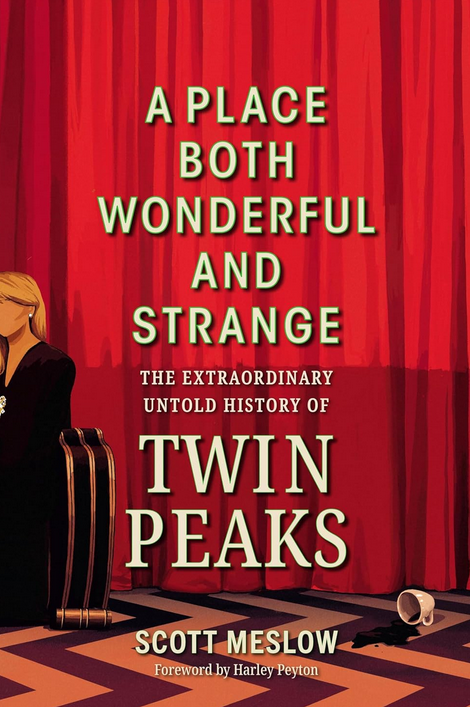
we have this highly readable and engaging tome by Scott Meslow, A Place Both
Wonderful and Strange, which is a blow-by-blow history of the making of
all the various cogs of Twin Peaks. Note that this is not one of those
academic analysis books, a “what does it all mean?” type of work that dominates
most of the non-fiction bibliography on Peaks. Nor is it a complete
“episode guide” (something fans sorely need that hasn’t really been done yet).
Instead, this is a behind-the-scenes account of how it all began, followed by
the evolution (and de-evolution) of the various incarnations of Twin Peaks.
The
book starts with David Lynch meeting Mark Frost, of course, and how they worked
together for at least a year before the idea for the series, then called Northwest
Passage, made it to a pitch-worthy level. We go through the jumping to
different networks, finally landing at ABC for a development deal and the subsequent
making of the glorious pilot episode. We learn how a European feature film was
part of that deal and how a tagged-on “ending,” the footage of which was later
used in an episode of the first season, was utilized for that purpose.
Meslow
takes the reader through the various stages of seasons one and two and how the
show was a huge success at first. But the author documents the network sabotaging
the second season so that the series would ultimately fail. Why did they do
that? The “talking heads” in the book—interviewees like
co-producers/writers/directors Harley Peyton and Robert Engels, as well as Mark
Frost himself—are candid in their speculative theories. (Sorry, Lynch did not
participate in the creation of the book prior to his untimely death in early
2025.)
But
as we know, Twin Peaks saw resurrection in two more lives in the feature
film and the third season—and Meslow details these steps, all the way to the
end.
Only
at times does Meslow offer his own interpretation of some of the storylines,
especially in The Return. But he acknowledges that it has always been
both Lynch’s and Frost’s desire that the audience make up their own minds “what
it all means.” Nevertheless, this turning back the red curtain to see the radical
and unorthodox inner workings of Twin Peaks is fascinating.
Both
wonderful and strange indeed. There was nothing like Twin Peaks in all
its forms, and Meslow tallies how it changed television. Many imitations
attempted to usurp its haunting power. There is a good argument to proclaim
that much of today’s streaming content would not exist without the
groundbreaking experiment that was Peaks.
Including
an insightful Introduction by Harley Peyton, Scott Meslow’s history of the Twin
Peaks sensation is a fan’s delight. Highly recommended.
Click here to order from Amazon